GNZA Prepares for Canton Fair 2026 with Pocket Luggage Built Around Faster Access
A sourcing event is most useful when the product conversation is specific
The 140th China Import and Export Fair is scheduled to open in Guangzhou on 15 October 2026. According to the organizer’s current timetable, the fair will run in three phases, with Phase 3 taking place from 31 October to 4 November. Cases and bags appear among the Phase 3 product categories. For international luggage buyers, that creates a concentrated moment to compare product direction, construction choices and supplier response in person.
GNZA plans to participate in the 140th Canton Fair. Its booth number, final display schedule and appointment details are still being prepared and will be announced separately. That distinction matters: this article does not invent a stand location or claim that a final exhibit list has already been confirmed. Instead, it explains the product thinking GNZA wants buyers to bring into the conversation—using front-pocket luggage as one clear example.
This is not a generic fair announcement. It is a preview of how Zhejiang Yinzuo Luggage Co., Ltd. turns a familiar travel product into an OEM/ODM development brief: define the user’s access problem, control the finished structure, coordinate the rest of the assortment and verify the sample before commercial release.
Event field | Verified / publication-safe wording |
Fair | The 140th China Import and Export Fair (Canton Fair) |
Official opening | 15 October 2026 |
Cases & Bags category | Listed within Phase 3, 31 October–4 November 2026 |
GNZA status | Participation planned; booth number, final schedule and appointment details to be announced separately |
Why the Canton Fair still matters for luggage development
A luggage specification is difficult to judge from a photograph alone. Buyers need to open the pocket, reach past the zipper line, check whether the loaded panel pulls forward, extend the trolley and roll the case while the front compartment is occupied. These actions reveal relationships between access, balance, internal volume and construction that are easy to miss in a static quotation sheet.
The fair also gives buyers a rapid comparison environment. The 138th Canton Fair reported more than 310,000 overseas buyers from 223 countries and regions. That historical result is not a forecast for October 2026, but it illustrates the scale and diversity of sourcing conversations the platform can support. A brand team can arrive with a broad idea—‘a more convenient business carry-on’—and leave with a sharper definition of pocket role, opening method, assortment and sampling priorities.
For GNZA, the value of the event is not simply visibility. It is the chance to compress early-stage communication. Material selection, external architecture, color, trims, branding and quality-control expectations can be discussed around the same physical reference instead of being separated across long email chains.
Pocket luggage is an access system, not just an extra zipper
The front pocket changes how a traveler uses the suitcase. Items needed during transit—documents, charging accessories, headphones or other small essentials—can be separated from the main packing area. The value comes from the sequence of use: what the traveler reaches for, how often, in which position and whether the case must be fully opened to retrieve it.
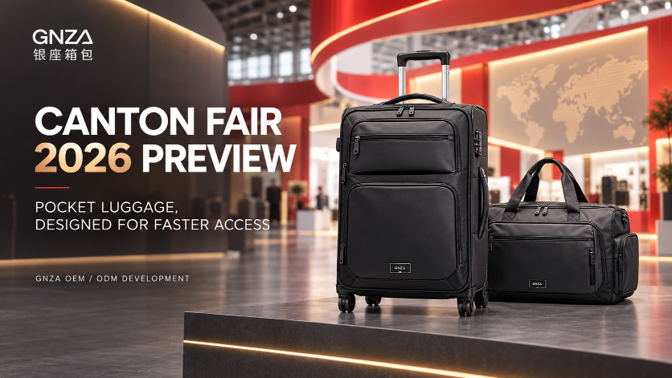
The GNZA 2026 collection reference used for this article is a black softside rolling case with an upper front compartment and a larger lower front pocket, presented with coordinated travel bags. The visible design suggests a business-oriented access hierarchy while keeping the main case recognizable as part of a broader collection. The catalog image does not publish a laptop size, material specification, airline compatibility claim or exact pocket capacity, so none is assumed here. Those details belong in the buyer’s brief and the approved sample.
That difference between visible concept and confirmed specification is essential in OEM work. A pocket can look generous yet become shallow after lining, reinforcement and trolley-tube clearance are considered. A buyer should therefore define the intended contents first, then ask the factory to translate them into pocket geometry and a physical prototype.
Three current brand approaches show the range of the category
Front-access luggage is already being interpreted in several ways. Monos positions its Carry-On Pro around a protected front compartment for quick access to a laptop and small essentials. July’s Carry On Pro uses a hard-shell format with a front compartment, a laptop sleeve and padded pockets. Briggs & Riley’s Sympatico Essential Front Pocket Carry-On combines a zippered front pocket and technology storage with an expandable spinner format. These examples are mentioned as independent market context; there is no stated commercial relationship between these brands and GNZA.
The useful lesson is not that one layout is universally better. It is that a front pocket is a system decision. A hard-shell door, a softside panel and an expandable construction distribute volume, reinforcement and opening forces differently. Even within one product name, the buyer still needs to decide whether the priority is device protection, document access, flexible storage, clean visual lines or maximum main-compartment efficiency.
A worldwide Google Trends comparison checked on 22 September 2026 points in the same editorial direction. Broad ‘carry on luggage’ terminology showed much more relative search interest than the feature-specific phrase ‘front pocket luggage.’ This is a scenario signal, not a market-size estimate. It suggests that content should first connect the product to the familiar carry-on need, then explain the pocket benefit in concrete use terms.
What GNZA should define with a buyer before sampling
First, map the access sequence. List the items intended for the upper pocket, lower pocket and main compartment. Record their dimensions and whether they need padding, organization, water resistance or one-handed access. If a device is involved, use the actual device envelope rather than a generic screen-size label.
Second, set the finished external envelope. The pocket panel, zipper track, piping and loaded depth all affect the suitcase profile. If the product is intended as a carry-on, the target airline and fare rules must be checked against the complete assembled case, including wheels and fixed handles. GNZA should not claim that one configuration is accepted by every airline.
Third, control weight distribution and stability. A loaded front compartment moves mass away from the case center. The trolley position, wheelbase, foot structure and pocket opening angle need to be evaluated together. The objective is not simply to add storage; it is to preserve predictable standing, rolling and opening behavior in the use condition agreed with the buyer.
Fourth, select the construction around the product promise. A softside pocket can support flexible organization and a coordinated textile collection, but the brief still needs decisions on reinforcement, lining, zipper routing, edge protection, handles, wheel set and branding. GNZA’s development role is to connect those choices rather than optimize one isolated component.
From one pocket case to a coherent travel collection
The reference image pairs the wheeled case with a duffle and a smaller shoulder bag. For a private-label buyer, that is commercially useful because the suitcase does not have to work alone. A coordinated range can repeat color, textile character, hardware finish, zipper language and logo placement while giving each product a different role in the trip.
Collection thinking also improves sourcing discipline. The buyer can nominate which components should be shared and which should remain product-specific. Shared pullers or trims may strengthen recognition; product-specific reinforcement may be necessary for load and movement. Agreeing that architecture early helps design, costing and sampling stay aligned.
GNZA was founded in 1991 in Pinghu, Zhejiang, and works across luggage and travel-product OEM/ODM development. Its relevant strength for this program is the ability to connect material selection, product and collection design, manufacturing, quality control and brand-guideline execution. The result should feel like the buyer’s brand, supported by a development system that can carry the idea from brief to repeatable production.
A practical buyer brief for the Canton Fair conversation
Buyers can make a fair meeting more productive by arriving with five decisions: the target market and sales channel; the exact pocket contents; the desired external size and empty-weight direction; the intended material and visual language; and the required test, compliance and brand-approval process. Order quantity, launch timing and packaging requirements should be included once they are internally approved.
The table below is deliberately framed as a discussion tool, not a completed specification. It separates what the reference product visibly communicates from what the buyer and GNZA still need to confirm. That approach prevents an attractive image from becoming an unsupported technical claim.
Pocket-luggage buyer brief
Decision area | Visible reference | Buyer + GNZA confirmation |
User and access sequence | Two visible front-access zones on the reference case | Exact contents, dimensions, frequency of access, padding and organization |
Finished external envelope | Wheeled softside case with retracted trolley | Target market, airline/fare set, all-in H × W × D including wheels and fixed handles |
Pocket architecture | Upper and lower front compartments | Opening angle, usable depth, reinforcement, zipper route, lining and load condition |
Mobility and stability | Spinner wheels and telescopic trolley visible | Wheel/trolley specification, loaded stability and handling verification |
Collection system | Coordinated wheeled case, duffle and shoulder bag | Shared colors, trims, pullers, logo rules and product-specific construction |
Commercial approval | Concept image only | MOQ, target cost, sample stages, test plan, compliance, packaging and launch timing |
What happens after the first conversation
A disciplined project should move through a short sequence: confirm the product brief, review drawings or construction proposals, make the engineering sample, check pocket usability with representative contents, verify the complete case and approve the production-intent sample. The verification plan should match the buyer’s market, product claim and applicable requirements; it should not be copied blindly from another program.
For GNZA, the Canton Fair can therefore be a starting point rather than the whole story. The most valuable outcome is not a crowded display. It is a buyer and manufacturer leaving the discussion with the same definition of access, structure, appearance and approval evidence.
Meet GNZA in the Canton Fair 2026 sourcing season
The official 140th Canton Fair calendar gives the luggage industry a clear October–November sourcing window. GNZA plans to participate, while its booth number, final on-site schedule and meeting instructions remain to be released. Buyers should follow GNZA’s official website and future company updates for confirmed participation details.
In the meantime, the pocket-luggage concept offers a useful place to begin. Send GNZA the target market, intended contents, dimensional direction, collection plan and brand requirements. The team can use those inputs to turn ‘faster access’ from a visual idea into an OEM/ODM brief that can be sampled, reviewed and prepared for production.
###communicates from what the buyer and GNZA still need to confirm. That approach prevents an attractive image from becoming an unsupported technical claim.