Meet GNZA at Asia Fashion Indonesia 2026
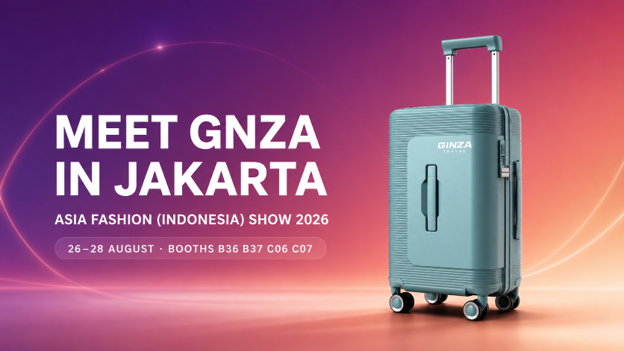
GNZA to Exhibit at Asia Fashion (Indonesia) Show 2026
A Jakarta meeting point for luggage sourcing, product development and market-ready collection planning
GNZA will meet the international fashion and travel-goods community in Jakarta this August. ZHEJIANG YINZUO CASES & BAGS CO., LTD. will exhibit at the 2026 Asia Fashion (Indonesia) Show from 26 to 28 August at Jakarta International Expo (JIEXPO), welcoming visitors at booths B36, B37, C06 and C07.
This is more than a calendar announcement. For buyers building luggage assortments for Indonesia and other markets, the show creates a practical setting to compare product directions, clarify specifications and discuss how an idea can move from a positioning brief to a manufacturable collection. The conversations will focus on real decisions: size architecture, shell and textile choices, construction, branding, target price and the checks required before production.
About GNZA: luggage development and manufacturing since 1991
Founded in 1991, ZHEJIANG YINZUO CASES & BAGS CO., LTD. is the company behind the GNZA brand. Based in Pinghu, Zhejiang, the business develops and manufactures luggage and travel products for brand owners, private-label programs and channel partners.
Today, the company operates 20 production lines and works with more than 100 global brands across over 80 countries, according to its current corporate profile. Its hard-shell expertise covers ABS, PC, PP and aluminium luggage, while its wider development scope includes wheeled luggage, backpacks, tote bags, cosmetic cases, luggage covers and coordinated travel accessories.
For B2B buyers, the relevant strength is an integrated development route. OEM programs can begin with the buyer's specifications and brand standards; ODM programs can begin with an existing design direction and then adapt structure, color, features and brand execution. The process can extend from concept design and 3D development through tooling, manufacturing, quality control, warehousing and logistics preparation.
Why Jakarta matters for the next luggage conversation
Indonesia combines a large domestic travel base with an increasingly connected consumer market. Statistics Indonesia (BPS) recorded 102.04 million domestic tourism trips and 1.01 million international visitor arrivals in January 2026. These figures are travel-activity indicators—not luggage sales but they help explain why product teams keep paying attention to travel convenience, trip length, transport rules and the role of luggage in everyday mobility.
The official Asia Fashion platform positions the event as a B2B trade fair for the fashion industry and includes bags and luggage among its core categories. That makes the Jakarta edition useful not only for discovering products, but also for bringing buyers, designers, sourcing teams and manufacturers into the same discussion while collection decisions are still open.
What local demand signals suggest for luggage buyers
A five-year review of Indonesian search behavior shows that “koper” is the main local category language, ahead of English terms such as “luggage” and “suitcase”. That does not remove the value of English product terminology in international trade. It means local-language naming should lead marketplace filters, product-page education and retail communication for Indonesian consumers.
The pattern remains active across several years rather than appearing as a single short-lived spike. Related questions increasingly focus on whether 20-, 22- and 24-inch cases are suitable for aircraft cabins. In practical terms, buyers need more than a good-looking case: they need clear dimensions, usable-capacity explanations and careful guidance around airline requirements.
How GNZA turns market questions into a product brief
A market observation becomes useful only when it changes a product decision. The development team therefore connects the buyer's channel and consumer questions with size architecture, materials, structure, price position and brand execution before the sample is locked.
An OEM/ODM development system buyers can discuss in Jakarta
At booths B36, B37, C06 and C07, the team will be available to discuss how a luggage idea can move through the company's development and manufacturing system. The purpose is not to push one universal case, but to define a route that fits the buyer's channel, consumer, brand language and commercial constraints.
• Concept and collection planning. Define the user, channel, size relationship and commercial role of each SKU before detailed engineering begins.
• Design and tooling. Develop form, construction and brand details, then review tooling or mold requirements against the intended volume and update cycle.
• Material and structure. Compare ABS, PC, PP, aluminium and other relevant directions against weight, appearance, durability targets and price position.
• Manufacturing and quality control. Set sample objectives, validation priorities, approval gates and change control before production decisions become costly.
• Brand and channel execution. Carry the design language into color, hardware, interior organization, packaging and channel-specific product communication.
Who should make time for a meeting
The discussion is especially relevant for luggage and travel-goods brands, importers, distributors, retailers, e-commerce operators, private-label
teams and corporate-gifting programs. It can also be useful for product managers who already have a concept but need clearer engineering boundaries, or commercial teams that want to refresh an existing range without losing its recognizable identity.
Visitors do not need a finished technical package. A concise market and channel brief is enough to start. The more clearly a team can define the target user, price segment and intended point of difference, the faster the booth conversation can move from generic capability claims to a realistic
product route.
How to prepare for a productive booth discussion
Bringing the following information will help the product team make the meeting more specific:
• Market and channel. Target country or region, retail channel, platform requirements and expected sales environment.
• Assortment role. Carry-on, check-in, coordinated set, business travel, family travel or another clearly defined use case.
• Design direction. Reference products, brand guidelines, preferred materials, color language and features that must be retained or avoided.
• Commercial frame. Target segment, expected volume range, launch timing and the decisions that are still flexible.
• Validation priorities. The performance risks, tests, compliance questions and packaging requirements that matter most for the program.
Meet the team in Jakarta
Asia Fashion (Indonesia) Show 2026 gives buyers a direct way to connect market questions with an established luggage-development system. GNZA is ready to turn the conversation into a practical development route.