Global Luggage Trends 2026: Product Mix Strategy | GNZA
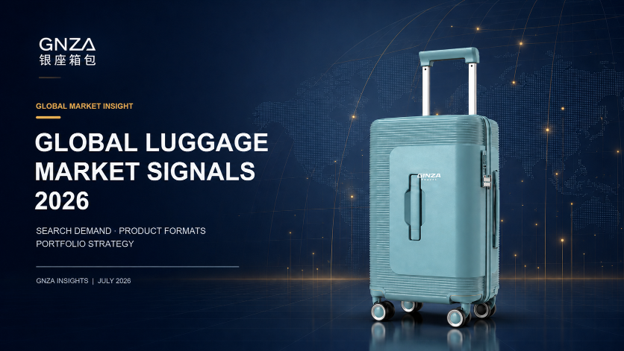
How GNZA Turns Global Luggage Demand Signals Into Smarter Product Mixes
Travel activity remains large, but 2026 is not producing one universal winner. Search behavior points to different jobs for carry-ons, hard-shell cases, premium metal luggage, soft products and accessories. The commercial question is how to convert those signals into a range that fits a channel, price architecture and production plan.
More travelers can expand the opportunity for travel goods, but volume alone does not tell a brand whether its next launch should lead with a
lightweight carry-on, a premium frame case, a softside family set or an accessory-led system. Founded in 1991 in Pinghu, Zhejiang, GNZA provides OEM and ODM development and manufacturing for luggage and related travel products. Its role in this analysis is not to declare a single winning material. It is to connect market attention with a product role, a technical route and a practical validation plan.
A Large Travel Market, but Not One Uniform Demand Curve
2025 AIR DEMAND | 2025 AIRPORT TRAFFIC | 2026 AIRPORT FORECAST |
+5.3% | 9.8 | 10.2 |
Sources: IATA 2025 full-year traffic; ACI World final 2025 airport traffic and its January 2026 forecast. RPK, airport passenger movements and luggage sales are different measures.
Air travel entered 2026 from a high base. IATA reported that global passenger demand, measured in revenue passenger kilometres (RPK), increased
5.3% in 2025; international demand rose 7.1%, while domestic demand grew 2.4%. ACI World later reported 9.8 billion airport passenger movements in 2025, 3.7% above 2024 and 6.5% above 2019. Those measures confirm the scale of travel activity, but neither is a luggage-sales series.
The more useful 2026 signal is unevenness. Through May, IATA's global RPK remained 1.1% above the prior year, even though May alone fell 2.2%.
Excluding the Middle East, May demand was 0.7% higher. Year-to-date growth ranged from 8.5% for African carriers and 7.3% for Latin American and Caribbean carriers to a 24.9% decline for Middle Eastern carriers. Because IATA assigns traffic by airline registration region, these figures should guide risk awareness rather than be read as direct consumer-market rankings.
For luggage teams, the implication is operational: assortment, inventory and launch timing should be planned by target region and channel instead of applying one global growth rate. A large airport system supports continued need for travel products; volatile regional demand argues for a portfolio with defined roles, controllable complexity and options for staged scaling.
What Google Trends Can—and Cannot—Tell Luggage Buyers
On 31 July 2026, we opened Google Trends and ran two worldwide comparisons covering the past five years, all categories and Web Search. The
first compared “carry on luggage,” “hardside luggage” and “softside luggage.” The second used the same carry-on anchor against “lightweight luggage” and “aluminum luggage.” The interface returned 262 weekly observations for each run, from 25 July 2021 through 26 July 2026.
Figure 1 | Google Trends: Worldwide, past five years, Web Search, all categories; collected 31 July 2026. Four-week moving average. The 0–100 index is normalized relative interest—not search volume, sales or market share.
The clearest pattern is hierarchy. In the second comparison, Google displayed five-year averages of 26 for “carry on luggage,” 3 for “lightweight
luggage” and 1 for “aluminum luggage.” In the first, the corresponding averages were 18 for carry-on, 4 for hardside and 1 for softside. Because Google normalizes every comparison set, these numbers do not mean that one term has a fixed multiple of another across the wider market. They do show that a broad travel format is a much larger search entry point than a material or construction attribute within these exact runs.
The weekly curves also show why a market analysis needs restraint. All five product terms rose sharply from late March through mid-May 2026—especially hardside—then moved back toward earlier bands by July. That is a time-bounded spike, not evidence of a permanent new baseline. A brand that treated the peak as a production forecast could overbuild inventory after interest normalised.
Related queries reveal the questions beneath the headline. Visible rising phrases included “lightweight carry on luggage with wheels,” “lightweight hardside luggage,” “lightweight luggage set” and “expandable hardside luggage.” Aluminum-related rising queries were heavily brand-modified,
including NOBL, Champs, LEVEL8, Sterling Pacific and Béis. This mix suggests that users move from a broad format to attributes, configurations and brand comparison. Rising percentages can be inflated by a low starting base, so they are best used to form hypotheses—not to promise demand.
THE DECISION RULE Google Trends can show attention, terminology, timing and regional concentration. It cannot show addressable market size, conversion, retail sell-through, margin, purchase orders or the production feasibility of a concept. A trend should generate a product hypothesis—not a production order. |
How GNZA Converts Signals Into a Commercial Development
Brief
Search data becomes useful only after the team defines the commercial job of each proposed SKU. GNZA uses six lenses to turn a signal into
a brief. They keep a fast-moving keyword from bypassing questions that determine whether a product can succeed in a real range.
Decision lens | Question to resolve | Development output |
Traveler and journey | Who uses it, for what trip and with which mobility needs? | Size, organization, perceived weight and handling priorities |
Target market | Which regions, terminology and airline or channel rules matter? | Market-specific dimensions, labeling and launch assumptions |
Sales channel | DTC, marketplace, wholesale, travel retail or department store? | Packaging, merchandising, returns exposure and assortment depth |
Price architecture | What are the retail and landed-cost targets? | Material route, component budget, feature allocation and margin room |
Portfolio role | Hero, core, entry, attach product or seasonal extension? | SKU hierarchy, design coherence and forecast concentration |
Scale and timing | What volume, tooling commitment and launch window are realistic? | Prototype plan, investment gates, production route and capacity timing |
The sequence is deliberate: search signal → market hypothesis → product role → material and structure → prototype → commercial validation.
Interest in aluminum luggage, for example, may support a premium halo hypothesis. It does not prove that an all-metal range is the right volume strategy. The team still needs to assess expected price, weight, hardware precision, appearance tolerance and whether a scalable PC companion product should carry most of the volume.
Different Materials Perform Different Jobs in a Product Portfolio
No material wins independently of the brief. A portfolio can use several routes because each one communicates and performs a different
commercial job.
Material route | Typical portfolio role | Main commercial implication |
PC | Core or premium-volume hard-shell line | Shell construction, finish and component integration remain decisive |
ABS | Entry, promotional or design-led rigid-shell line | Cost allocation should protect visible touchpoints and load areas |
PC+ABS | Mid-market bridge | The blend, thickness and construction require explicit specification |
PP | Lightweight, functional or forecast-led range | Tooling, geometry, finish and expected volume need early alignment |
Aluminum-magnesium | Premium halo or statement product | Precision, hardware, weight and cosmetic expectations require control |
Textiles | Softside, backpack and accessory extension | Fabric, coating, seams, lining, zippers and trim need separate definitions |
Public brand ranges illustrate the principle. RIMOWA presents aluminum and polycarbonate as distinct premium stories. Away publishes
polycarbonate, aluminum and nylon across different product roles and explains whole-case testing. Samsonite's corporate history covers multiple material platforms and tiers. DELSEY PARIS connects materials with lightness, security and organization, while Briggs & Riley emphasizes repairability and ownership lifecycle. These companies are independent market references, not stated GNZA customers or partners. The lesson is not to copy a brand's material; it is to define the job each product must perform.
Three Product-Mix Scenarios for Different Commercial Strategies
1. The Digital-First Carry-On System
For a DTC or marketplace launch, the hero may be a lightweight PC, PP or commercially specified PC+ABS carry-on. A compact travel backpack extends the range into daily use, while a cosmetic case, organizer or luggage cover creates a lower entry point and bundle option. The carry-on carries the main visual identity; the companion products increase use occasions without forcing the range to depend on several suitcase sizes from day one.
Search evidence makes carry-on a logical discovery format, but product development still starts with the target market. Cabin dimensions are
not universal, and airline rules can change. Weight, wheel and handle feel, shell finish, interior organization, parcel packaging and return exposure all
affect the online proposition. GNZA can coordinate luggage, backpacks and accessories so that color, hardware language, trim and packaging feel like one system rather than unrelated catalogue items.
2. The Premium Halo Collection
A design-led brand may use an aluminum-magnesium frame carry-on or statement case as the halo product, then create a premium PC zipper or frame case as the scalable volume driver. A business backpack, tote or cosmetic case can extend the same visual language into a more accessible product. The metal case establishes recognition and tactile authority; the PC product broadens the price architecture; the soft product expands use occasions.
Metal alone does not create luxury. The critical work sits in frame, lock, hinge, corner, wheel and handle alignment; surface consistency; weight
expectations; sound and touch; packaging; and color matching across unlike materials. GNZA's product-development role is to make those details reinforce one brand promise while keeping the halo product and the volume product commercially distinct. Unsupported claims such as “indestructible” or “the strongest” should be replaced by project-specific specifications and agreed tests.
3. The Multi-Channel Price-Ladder Collection
Importers, distributors and retail groups may need several price points. An ABS or specified PC+ABS case can serve an entry role; PC, PC+ABS or
PP can form the core depending on cost, weight and forecast; softside luggage, backpacks, totes or accessories can add breadth. Shared design cues keep the range recognizable while each tier has a clear reason to exist.
The risk is uncontrolled SKU expansion. A broader catalogue is not automatically a stronger portfolio if volume is split across too many sizes,
colors and features. GNZA therefore treats common components, color systems, packaging by channel, tooling assumptions, replenishment and feature allocation as commercial decisions. The objective is a price ladder that preserves brand logic—not the same case reproduced with small cosmetic changes.
How GNZA Moves From a Product-Mix Hypothesis to Production
A product mix is not complete because renderings share a color. Collection coherence also comes from proportions, wheels, handles, closures,
trims, interior organization, graphics, packaging and the way products sit together at retail. The development system must carry the approved commercial intent into measurable product and production controls.
Stage | GNZA development focus |
1. Market brief | Confirm target traveler, market, channel, price architecture, range roles and timing |
2. Route selection | Compare materials, structures, tooling, components and cost dependencies |
3. Collection design | Align CMF, proportions, interfaces, graphics and packaging across product types |
4. Prototype | Build and review samples against the commercial and technical brief |
5. Validation | Agree test methods, acceptance criteria, appearance standards and approval samples |
6. Pre-production | Freeze drawings, bills of materials, component versions, packaging and control points |
7. Manufacturing control | Monitor approved requirements through production, inspection and release |
The validation plan is brief-specific. It may include the shell or fabric, wheel system, trolley, handles, closure, interior, dimensions, appearance and packaging, but methods and acceptance thresholds must be agreed rather than inferred from a material name. GNZA participated in a 2026 FIFA
World Cup licensed travel-products project, applying its product-development, manufacturing, quality-control and brand-compliance capabilities. The event has concluded; the reference is historical process evidence and does not imply sponsorship or a current sales window.
Validate the Market Hypothesis Before Scaling It
Google Trends is the first layer of evidence, not the final business case. Before committing a collection to tooling or inventory, GNZA recommends
that the brand combine several evidence types.
Evidence layer | What it helps answer | What it still cannot prove |
Google Trends | Attention, terminology, timing, seasonality and relative regional concentration | Absolute demand, conversion, margin or sell-through |
Keyword Planner / search ads | Estimated query volume, competition and paid-search economics | Product satisfaction or wholesale demand |
Retailer / marketplace data | Price bands, ratings, velocity, returns and competitor assortment | Whether a copied specification fits the brand |
CRM and buyer inquiries | Qualified needs, objections, project timing and channel interest | Mass-market demand without enough observations |
Samples and testing | Product feel, technical feasibility, acceptance criteria and improvement priorities | Commercial scale without a channel and forecast |
Pilot launch | Conversion, attach rate, returns, repeat demand and inventory behavior | Long-term performance from a short test alone |
This evidence ladder also explains the 2026 spring spike: it is worth investigating, but not extrapolating. A buyer can test whether the same product-format language appears in ad planning, marketplace demand and live inquiries. If the signal survives those checks, the team can move from prototype to a controlled pilot before scaling the full range.
What Buyers Should Decide Before Requesting Samples
A strong sample request describes a commercial system rather than an isolated case. The most useful brief includes the launch market, channel,
intended traveler, target retail and landed-cost tier, hero/core/entry/attach roles, benchmark products, dimensions and weight target, preferred material direction, finish and decoration, closure and component architecture, compliance and test requirements, estimated volume, launch timing and assortment plan.
A clear brief does not eliminate iteration; it makes iteration more valuable. It lets GNZA explain why a route is recommended, which alternatives
remain open and which changes affect tooling, cost, timing, packaging or external claims. It also gives the buyer a clearer internal decision record
before samples multiply.
GNZA Builds Product Mixes Around Commercial Fit, Not
Trend-Chasing
The 2026 luggage market is supported by a large travel base, but its signals are layered. Air demand is regionally uneven. Search interest can rise
quickly and then normalise. Broad format language attracts more attention than narrower material terms, while attribute and brand modifiers reveal how evaluation becomes specific. None of those signals selects a product by itself.
GNZA connects the evidence to product roles, materials, collection design, prototypes, validation and repeatable manufacturing. The strongest
range is not the one that follows every keyword. It is the one in which every SKU has a commercial job, a coherent place in the brand and a feasible route to market.
DISCUSS YOUR NEXT PRODUCT MIX WITH GNZA Planning a luggage or travel-product collection? Share your target market, sales channels, price architecture, benchmark products, preferred material direction, estimated volume and launch timing. GNZA can use that brief to discuss suitable product roles, technical routes and a practical sampling direction. Visit www.zjyinzuo.com/en. |