Luggage Export Packaging Guide: How GNZA Ships to 80+ Countries
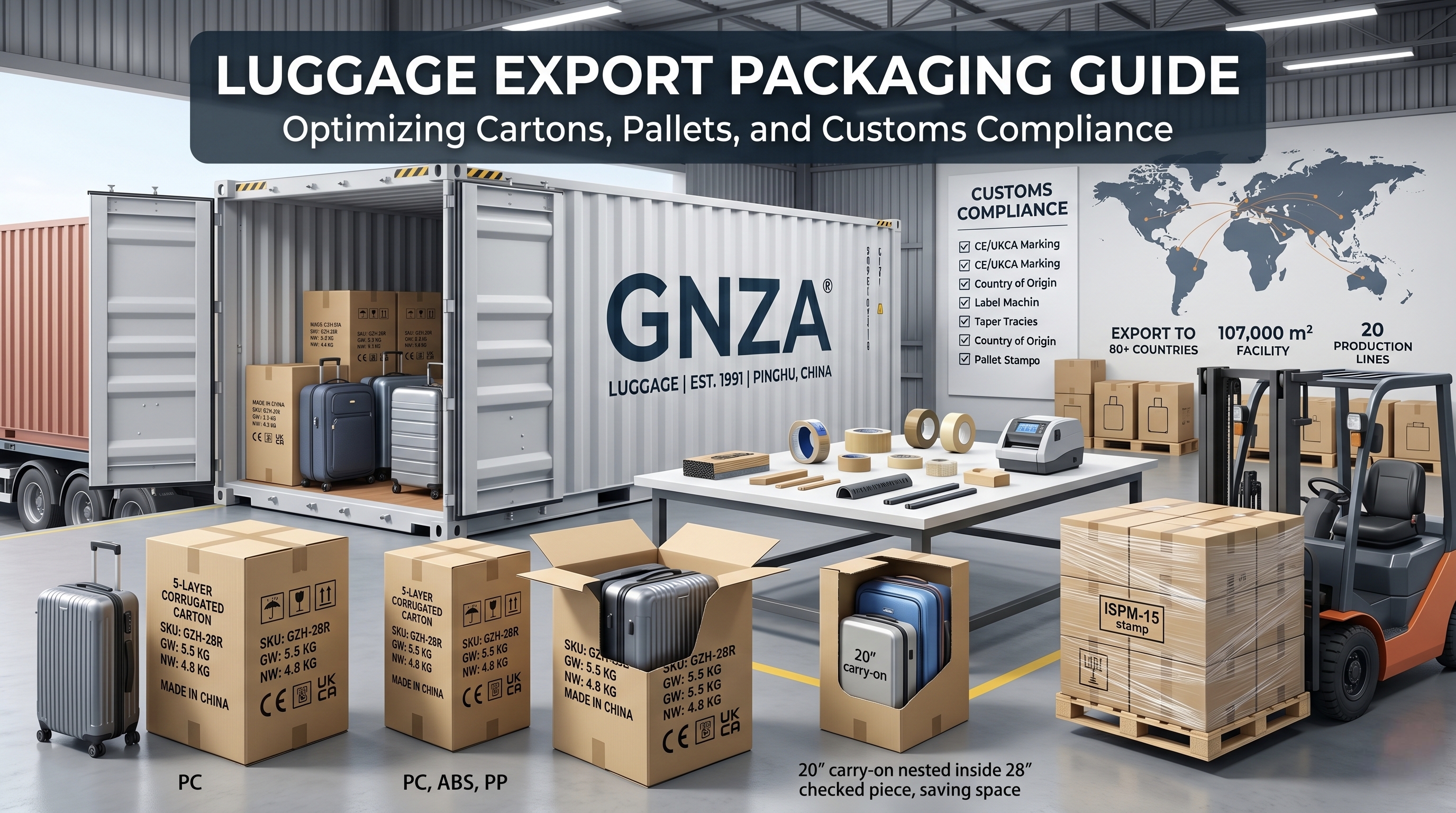
A 24-inch hardside luggage piece weighs around 3.6 kg empty. A 40-foot high-cube container loaded with mixed sizes typically holds 480 to 560 finished pieces, depending on whether they are shipped nested or individually bagged. The difference between those two numbers is the difference between a healthy gross margin and a freight cost that quietly destroys it.
This guide covers the four packaging decisions that determine landed cost on a luggage export shipment, plus the labeling and documentation issues that hold the most containers at customs.
Single-piece versus nested packaging
Two configurations are standard for hardside luggage exports.
Single-piece packaging puts each suitcase in its own carton. The carton protects the shell from scratches, allows individual SKU handling at the destination warehouse, and is required by most major retailers. The downside is air. A single-piece carton wastes 30 to 40 percent of its internal volume on padding and headspace, and that volume is what you pay freight on.
Nested packaging slides a smaller piece inside a larger one, typically a 20-inch carry-on inside a 28-inch checked piece. Each nested pair goes into a single shared carton. The volumetric savings are significant: a 40HC container that fits 480 single-piece SKUs will fit 540 to 560 nested pairs, a 12 to 17 percent gain on freight per unit.
The trade-off is destination handling. Nested cartons have to be split before they hit retail shelves, which means an additional handling step at the warehouse. Most DTC brands ship nested. Most retail buyers ask for single-piece.
Carton specifications and standard configurations
Cartons for export luggage are made from five-layer corrugated board, typically with a burst strength of 250 to 320 kPa. The standard sizes for a 20-inch carry-on are 56 by 38 by 24 cm, and for a 28-inch checked piece, 78 by 50 by 32 cm. These numbers are not arbitrary — they correspond to the most efficient pallet stacking configurations under European and US ISPM-15 standards.
The carton should include four printed elements at minimum: SKU code, country of origin, gross and net weight, and a fragile or handle-with-care indicator. For shipments to the European Union, add a CE label if the product carries an electronic component. For shipments to North America, add the importer of record details.
Each carton should also carry a small production batch number that ties back to the QC inspection report. This is what allows you to identify which container had the bad zipper run if a quality issue surfaces six months later.
Pallet versus floor-loaded
A pallet adds about USD 12 to 18 of cost per pallet (heat-treated wood, fumigation, ISPM-15 stamp). It also subtracts space — a euro pallet displaces around 0.6 cubic meters of container volume even before the cartons go on top.
For luggage, the right choice depends on the destination warehouse. European retail DCs almost always require palletized inbound shipments. US and Canadian DCs are split: some require pallets, some prefer floor-loaded for higher container utilization. Southeast Asian and Middle Eastern receivers usually take floor-loaded without complaint.
Floor-loaded shipments fit roughly 15 percent more units per container. For an order of 5,000 pieces, that is the difference between one container and two, and about USD 3,800 in freight at 2026 ocean rates.
Labeling: CE, country of origin, retail-ready
Five labeling elements are required for export-ready luggage going to most destinations.
Country of origin marking is mandatory in nearly every market. For the United States, this is enforced under 19 U.S.C. 1304 and the marking must be conspicuous and permanent. A removable hangtag is not sufficient — the country of origin must be printed, stamped, or molded directly onto the product or a permanently attached label.
CE marking is required in the European Union for any product with electronic components. Intelligent luggage with built-in scales, GPS tracking, or USB passthrough must carry CE and ship with a Declaration of Conformity. The same shipment will need RoHS compliance documentation.
UK markets now require UKCA marking, which is technically separate from CE despite covering the same scope. As of 2026, CE marks are still accepted in the UK for most categories, but the timeline for UKCA-only enforcement keeps shifting. Maintain both.
Retail-ready labeling — barcodes, hangtags, retail packaging copy — is buyer-specific. Confirm the spec in the PO, not in email. Mistakes here are not customs issues, but they trigger chargebacks.
The five most common customs holds
Five issues account for the majority of customs holds on luggage shipments.
Missing or incorrect country of origin marking is the most frequent. The fix is to mark the product permanently, not just the carton.
HS code mismatch between the commercial invoice and the actual product is the second. Hardside luggage is HS 4202.12; softside is HS 4202.91 or 4202.92 depending on material. A wrong code triggers a duty recalculation and a hold.
Missing CE or RoHS documentation on intelligent luggage. Even if the electronics are minor, EU customs will hold the shipment until the Declaration of Conformity arrives.
Wood pallet without ISPM-15 stamp. This is rare but catastrophic — the entire container can be refused and re-exported at the importer’s cost.
Discrepancy between the packing list and the physical count. A shipment listed as 1,200 pieces that contains 1,198 will sit at the dock until a customs broker amends the paperwork.
What this means for your sourcing decision
A factory that ships to over eighty countries has dealt with all five of these issues, repeatedly, and has the documentation templates to prevent them. A factory that ships mainly to one or two markets does not. When evaluating a Chinese luggage supplier, ask to see a sample export documentation packet — commercial invoice, packing list, certificate of origin, and any product certifications — for a recent shipment to a market similar to yours. The supplier who can produce this in an hour is the supplier whose container will not get stuck at the destination port.