ABS vs Polycarbonate Luggage: Which Material Is Right for Your Brand?
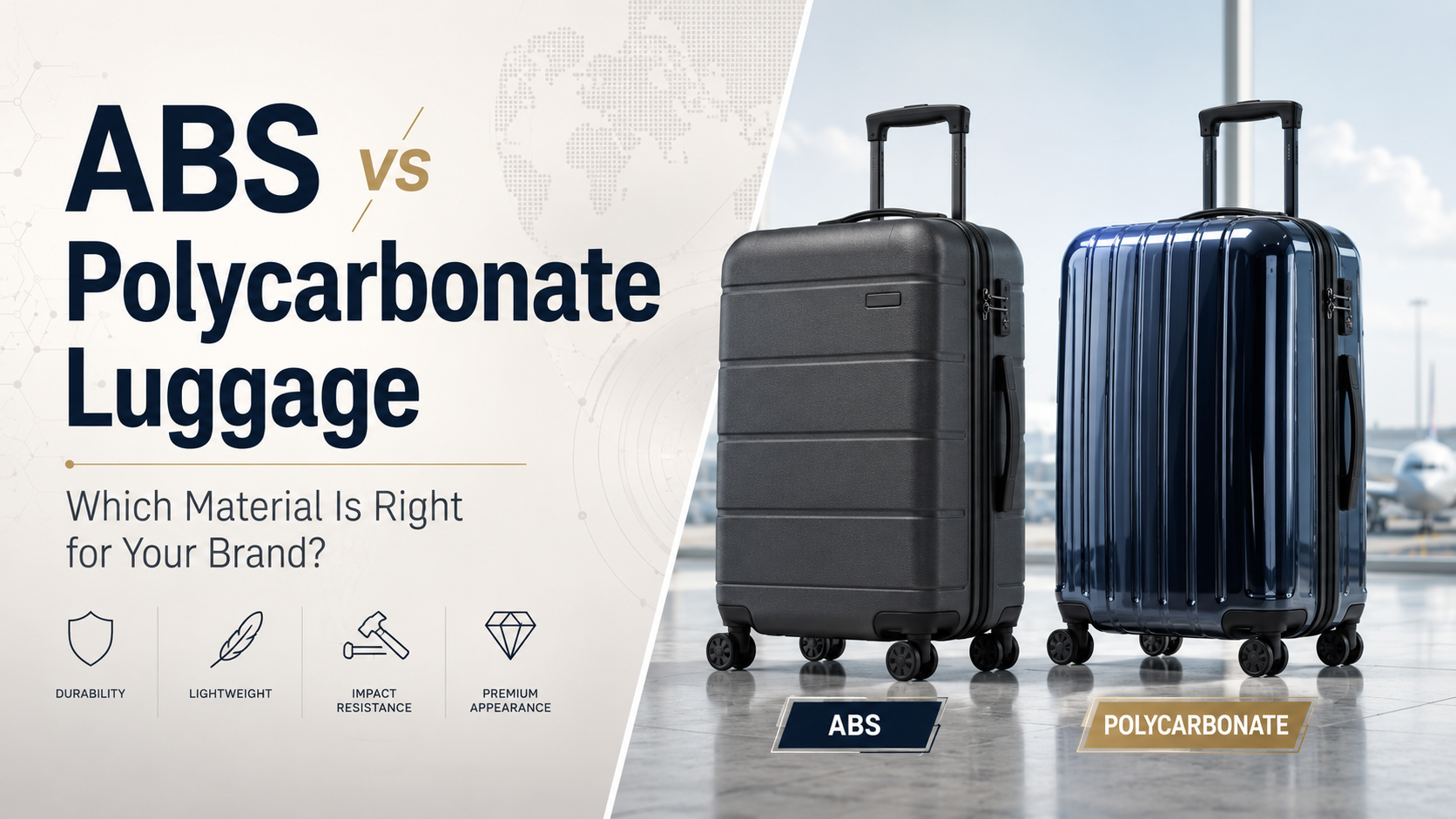
ABS vs Polycarbonate Luggage: Which Material Is Right for Your Brand?
For luggage brands and manufacturers, material selection is a foundational decision. The choice between ABS and polycarbonate determines not just durability and weight, but also your product's price positioning, manufacturing lead time, and target customer.
Industry estimates suggest that ABS and polycarbonate together account for over 85% of the global hardside luggage market. Yet many brand owners lack clarity on when to choose one over the other. This guide breaks down both materials, helping you make an informed decision aligned with your market segment and profitability goals.
Why Material Matters: The Hidden Impact on Brand Perception
Your luggage's material isn't just engineering—it's a signal to your customer.
• Budget segment ($80–$150): Customers expect durability but accept lighter-weight plastics and modest feature sets. ABS dominates here.
• Mid-market ($150–$300): Balance of durability, weight, and design flexibility becomes critical. Polycarbonate gains share.
• Premium segment ($300+): Customers demand lightweight, impact-resistant luggage with superior aesthetics. Polycarbonate and hybrid materials prevail.
The material you choose impacts:
• Unit cost (directly affecting margin)
• Production lead time (affecting your time-to-market)
• Design flexibility (what shapes and colors are feasible)
• Repair & warranty strategy (how easily can a wheel or hinge be replaced?)
ABS Luggage: The Workhorse Material
ABS (Acrylonitrile Butadiene Styrene) is a thermoplastic copolymer—a blend of three monomers that creates a rigid, cost-effective plastic.
Advantages of ABS
Lower cost: ABS material costs 20–30% less than polycarbonate per kilogram. For a 24-inch checked bag, ABS averages $12–$18 in material cost vs. $16–$24 for PC.
Easier processing: ABS has a lower melting temperature and shorter cycle time in injection molding. Factory lead time compresses: standard ABS carry-ons can ship in 8–10 weeks vs. 10–12 weeks for polycarbonate.
Excellent rigidity: ABS offers superior stiffness at lower wall thickness. This matters for TSA-lock integration, hinge durability, and corner reinforcement. Budget luggage leverages ABS's structural strength to reduce material costs further.
Color flexibility: ABS accepts a broader range of pigments and can achieve deeper, more saturated colors without UV degradation. Matte finishes and complex color patterns are more feasible (and cost-effective) in ABS.
Repairability: ABS is easier to weld or glue for repairs. A broken corner or hinge can be re-molded on-site with heat and adhesive. Polycarbonate repairs are more expensive.
Disadvantages of ABS
Lower impact resistance: ABS becomes brittle at cold temperatures (below 0°C). Luggage dropped on concrete at winter temperatures shows micro-cracks more readily. Over its 5–7 year lifecycle, repeated impacts may cause stress fractures.
Staining and scratching: ABS is prone to scuffs and marks. Budget luggage in matte black ABS shows every fingerprint. Premium brands typically avoid deep blacks or invest in protective coatings.
Shorter lifespan: While adequate for 2–3 year cycles (typical for budget segments), ABS luggage degrades faster under UV exposure and temperature swings. By year 5–7, corners may crack and hinges may weaken.
Less premium feel: Higher-end customers associate ABS with budget luggage. Perceived quality suffers at price points above $200, where customers expect polycarbonate or hybrid materials.
Polycarbonate Luggage: The Premium Choice
Polycarbonate (PC) is a thermoplastic polymer known for exceptional impact resistance and light weight.
Advantages of Polycarbonate
Superior impact resistance: Polycarbonate's molecular structure makes it 250–300 times stronger than glass. Drop tests (ASTM impact standards) consistently show PC luggage surviving higher-force impacts without cracking. This durability justifies premium pricing.
Lightweight: Polycarbonate achieves rigidity at 15–20% lower density than ABS. A 24-inch PC spinner weighs roughly 1.5 lbs less than equivalent ABS luggage—meaningful when customers are paying per-kilogram on airlines.
Extended lifespan: With proper care, PC luggage lasts 7–10+ years. It resists UV degradation and cold-temperature brittleness better than ABS. Warranty claims drop significantly with PC.
Glossy, premium finish: Polycarbonate's natural sheen and smooth surface feel premium. High-gloss finishes emerge from the mold without additional coating, reducing production steps.
Better for lightweight designs: When designing ultra-light carry-ons (under 4 lbs), polycarbonate's strength-to-weight ratio is essential. ABS walls must be thicker to achieve equivalent stiffness, negating the weight advantage.
Disadvantages of Polycarbonate
Higher material cost: PC resin costs 20–30% more than ABS. For a mid-market brand sourcing 5,000 units annually, this difference compounds.
Limited color palette: Polycarbonate requires UV stabilizers to prevent yellowing and discoloration. Deep colors (black, navy, burgundy) are challenging and often require custom pigmentation or coatings—adding cost and lead time.
Matte finishes require coating: Matte PC finishes are not inherent; they require applied surface treatments (spray, texture, or coating). Budget adds 8–15% to production cost. ABS matte finishes emerge directly from the mold.
Longer production lead time: Polycarbonate's higher melting temperature and longer cooling cycle extend production by 2–4 weeks per batch. If you need 8-week delivery, polycarbonate demands 12+ weeks.
More expensive repairs: Polycarbonate cracks cannot be welded or glued effectively. Repair often requires mold replacement or acceptance as non-warrantable. Warranty replacement becomes the fallback.
PC+ABS Hybrid Luggage: The Balanced Approach
Many manufacturers blend both materials—polycarbonate exterior + ABS interior frame, or vice versa—to balance cost and performance.
PC shell + ABS frame: Captures polycarbonate's premium feel and impact resistance on the visible surface while using ABS for hidden structural components. Cost reduction: 8–12% vs. full PC. Used by mid-market brands targeting $150–$250 price points.
ABS exterior + PC reinforcement: Budget-forward approach. ABS forms the main structure; polycarbonate is added to high-impact zones (corners, edges, wheel wells). Minimal cost premium (3–5%) but noticeably improved durability. Popular for economy lines positioning toward $100–$150 segments.
PC+ABS resin blends: Advanced approach where pellets of mixed PC and ABS are molded together. This hybrid material offers ~40% of ABS's cost savings with ~80% of polycarbonate's impact resistance. Used by leading Chinese manufacturers for mid-to-premium segments. Material cost: $14–$20 per unit.
Side-by-Side Material Comparison: Specifications
Property | ABS | Polycarbonate | PC+ABS Hybrid |
Material Cost (per unit) | $12–$18 | $16–$24 | $14–$20 |
Impact Resistance (IZOD) | 4.0–5.5 J/cm | 12–16 J/cm | 7–10 J/cm |
Tensile Strength | 40–50 MPa | 60–70 MPa | 48–58 MPa |
Density | 1.04–1.06 g/cm³ | 1.19–1.20 g/cm³ | 1.08–1.12 g/cm³ |
Melting Temperature | 220–250°C | 310–340°C | 230–280°C |
Moldable Colors | 100+ | 20–30 (without coating) | 50–70 |
UV Stability (years) | 3–5 | 7–10 | 5–8 |
Cold Brittleness | High (below 0°C) | Low | Low–Medium |
Repair Feasibility | High (weldable) | Low (brittle when broken) | Medium |
Price Perception | Economy–Budget | Mid-Market–Premium | Mid-Market |
Production Lead Time | 8–10 weeks | 10–12 weeks | 9–11 weeks |
GNZA's Material Expertise: 34 Years of Manufacturing Data
Based on GNZA's production database (1991–2025), here's how material selection aligns with market tier and profitability:
Budget Tier ($80–$150): ABS dominates. At these price points, customers are cost-sensitive but expect functional, durable luggage for 2–3 trips per year. ABS delivers. Margin: 35–45%. Production: 60–70% of customer inquiries.
Mid-Market Tier ($150–$300): Mixed portfolios win. Brands offer ABS carry-ons (faster inventory turns, higher margin) alongside PC checked bags (premium positioning, customer loyalty). Hybrid PC+ABS increasingly common. Margin: 40–50%. Strategy: Offer choice based on use case.
Premium Tier ($300+): Polycarbonate and specialty materials. Customers expect 7+ year durability, lightweight design, and extended warranty. ABS signals "not premium." Hybrid blends are acceptable only if design excellence compensates. Margin: 45–60%. Production: 15–20% of inquiries.
Airline/Wholesale Channel: Mixed. Budget airlines demand lowest cost (ABS). Premium carriers specify polycarbonate or hybrid for brand consistency. Partner with factories offering both to serve diverse channels.
How to Test and Validate Material Choices
Before committing to production, validate material performance:
Impact Testing: Drop samples from 3 feet onto concrete. Polycarbonate shows no cracks; ABS may show stress lines or micro-cracks (especially at cold temperatures).
Stress Testing: Press hard on corners and edges with hand pressure. PC resists deformation; ABS may show permanent indentation or flex.
Weight Verification: Use a scale to confirm. PC 24-inch spinners typically 4.5–5.5 lbs; ABS 24-inch spinners 5.8–6.5 lbs.
Color Consistency: Request 5 samples in your target color from different production batches. Polycarbonate may show slight color variation (common); ABS should match precisely.
Finish Quality: Run your hand along the surface. Polycarbonate glossy finishes feel smooth; ABS may feel slightly grainy (depending on mold quality).
Frequently Asked Questions
Q1: Can I start with ABS and upgrade to polycarbonate later?
A: Yes, but avoid one-off switches. Order ABS for your first collection, gather customer feedback, then commit to polycarbonate for a distinct "premium line" launch. Messaging matters: "Our original collection in durable ABS; introducing [Brand] Premium in lightweight polycarbonate." Avoids cannibalizing ABS sales.
Q2: Is polycarbonate worth the extra cost?
A: If your price point is above $150 and your target customer values durability and weight, yes. At $80–$150, ABS is sufficient. At $200+, customers expect polycarbonate or hybrid. Test market demand: survey 20–50 potential customers. If 60%+ prefer "durable, lightweight" over "budget-friendly," invest in PC.
Q3: What about aluminum luggage? How does it compare?
A: Aluminum is premium ($400–$1,000+), heavier than PC, and significantly more expensive to produce. Reserved for ultra-luxury and specialty travel brands. For most B2B buyers, polycarbonate is the highest ROI choice.
Q4: How does temperature affect material choice?
A: For customers in cold climates (Canada, Northern Europe, Russia), specify polycarbonate. ABS becomes brittle below 0°C and shows micro-cracks after impacts in winter conditions. This is a significant customer pain point in northern markets.
Q5: Can I mix materials in one luggage (PC shell, ABS interior)?
A: Absolutely. This is industry best practice for mid-market brands. Polycarbonate exterior for premium feel; ABS frame components for cost efficiency. No compromise on performance, 10–15% material cost reduction. GNZA uses this approach for 40% of custom OEM orders.
Conclusion
The ABS vs. polycarbonate choice is not absolute—it's a strategic alignment with your brand positioning, price point, and customer expectations.
Choose ABS if you're targeting budget-conscious buyers ($80–$150), need fast production (8–10 weeks), and want to maximize margin. Accept a 5–7 year product lifecycle.
Choose Polycarbonate if your price point is $200+, you're competing on durability and weight, and your customers value extended warranties and premium aesthetics.
Choose PC+ABS Hybrid if you're mid-market ($150–$300), want the best balance of cost and performance, and your customers span diverse use cases (business travel, family vacations, lightweight commuting).
The right choice depends not on which material is "better," but on which aligns with your brand promise to your customer.
Want Expert Guidance on Material Selection?
Contact an expert consultant to evaluate your brand's specific needs, price point, and customer expectations. We'll help you choose materials that maximize durability, minimize production cost, and exceed customer expectations.