Luggage Manufacturing Cost Breakdown: What Affects Your Unit Price in 2026
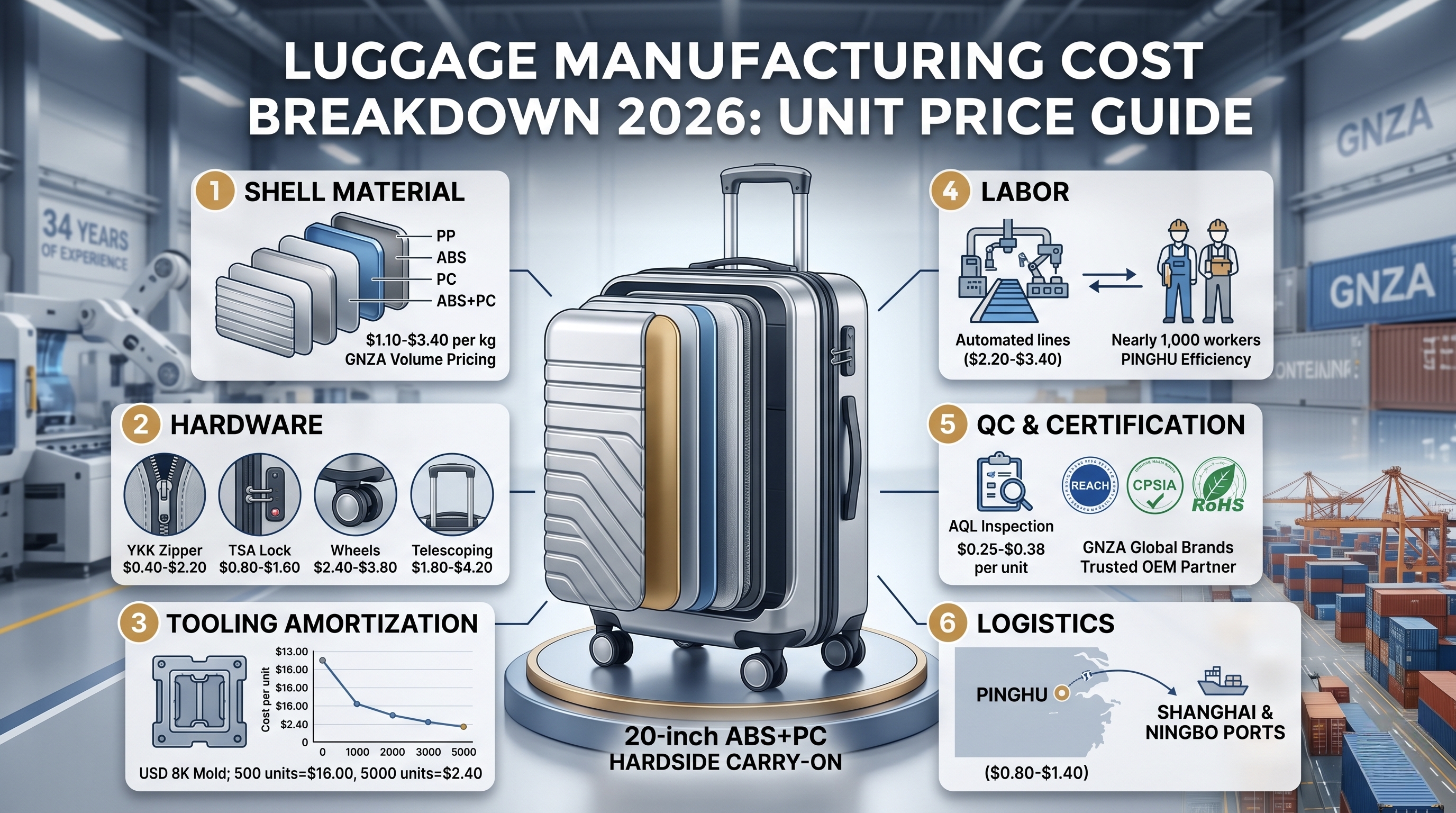
A 20-inch ABS+PC carry-on with TSA lock and dual spinner wheels costs between USD 19 and 34 to manufacture in a Chinese factory in Q1 2026, depending on shell weight, tooling amortization, and order quantity. The 79 percent spread between the floor and the ceiling of that range is not a negotiation game. It is a function of six structural cost drivers, every one of which a procurement manager can model in advance. This article walks through the six drivers and ends with three real cost stacks for orders of different sizes.
Driver 1: Shell material
The shell is the largest single cost component. Four materials dominate the hardside category in 2026.
Polypropylene (PP): Raw PP resin sits at roughly USD 1.10 to 1.30 per kilogram, and a 20-inch PP shell uses 1.4 to 1.7 kg of material. Used widely in the value tier.
ABS is the workhorse for mid-tier hardside. Resin cost is USD 1.40 to 1.70 per kg. Lighter than PP for the same shell volume, slightly less impact resistant. Easier to mold in complex shapes.
Polycarbonate (PC) is the premium hardside material. Resin cost is USD 2.80 to 3.40 per kg. Lighter and stronger than ABS, with a glossier finish. The cost per shell is roughly double a comparable ABS piece.
ABS+PC composite: Cost lands between pure ABS and pure PC, around USD 1.90 to 2.30 per kg of shell weight. At GNZA, our 34 years of manufacturing experience across PC, ABS, and PP means we process thousands of tons of these resins annually on our 20 professional production lines, securing volume-based material pricing for our OEM buyers..
Driver 2: Hardware
Hardware is the second largest cost block. Zippers run from USD 0.40 (a basic Chinese-brand nylon coil) to USD 2.20 (a YKK metal-tooth zipper with sealed tape). TSA-approved locks add USD 0.80 to 1.60. Cheap wheels cost USD 0.60 per pair and start losing bearings within 2,000 km, while premium spinner wheels cost USD 2.40 to 3.80 per set of four. The telescopic handle costs USD 1.80 to 4.20 depending on aluminum gauge and the number of stops.
Driver 3: Tooling amortization
A new shell mold for a luggage piece costs USD 4,000 to 18,000. Tooling cost amortizes across your first production run: a USD 8,000 mold spread over 500 units adds USD 16 to the per-unit cost, but spread over 5,000 units adds only USD 1.60. This is the single biggest reason small first orders feel expensive. Because GNZA operates a massive 107,000-square-meter facility with strong in-house tooling capabilities, we offer transparent ownership transfer terms and flexible amortization structures that protect our clients' margins.
Driver 4: Labor
Direct labor cost on a 20-inch hardside carry-on is between USD 2.20 and 3.40 in 2026, depending on automation level and factory location. Coastal Guangdong factories tend toward the higher end of this range; inland factories are cheaper but have longer outbound logistics.
Labor cost has been creeping up by 4 to 6 percent annually in Chinese luggage factories since 2022. This is one of the structural reasons that pure-PP value-tier production has been migrating to Vietnam and Indonesia, where direct labor cost is roughly 40 percent lower. ABS, PC, and aluminum production has stayed in China because the supplier ecosystem (zippers, hardware, wheels, surface finishing) is dense enough to outweigh the labor differential.
Driver 5: QC and certification
Quality control is a small line item but a critical one. A standard third-party AQL inspection from SGS, Bureau Veritas, QIMA, or Intertek costs USD 250 to 380 per inspection day. For a 1,000-unit order, this works out to USD 0.25 to 0.38 per piece.
Certifications that the buyer requires — REACH for the EU, CPSIA for the US, RoHS if there are electronics, EN 12281 for office-use luggage — each add a one-time cost of USD 400 to 1,500. These are not per-unit costs but they need to be amortized across the order they certify.
Driver 6: Logistics from factory gate to FOB
Inland transport from a Zhejiang factory to Ningbo or Shanghai port runs USD 0.80 to 1.40 per piece. Container loading and customs clearance for export adds another USD 0.30 to 0.60. Located in Pinghu, GNZA is geographically situated at the heart of China's luggage manufacturing hub, just a short drive from both Shanghai and Ningbo ports. This strategic location ensures our local logistics costs consistently stay at the absolute minimum of this spectrum.
Putting it together: three real cost stacks
Here are three stacks for a 20-inch ABS+PC carry-on with mid-spec hardware, drawn from actual GNZA quotes in Q1 2026.
Order of 500 units, single SKU, custom mold. Shell material: USD 5.20. Hardware: USD 5.80. Labor: USD 2.80. QC: USD 0.34. Logistics to FOB: USD 1.20. Tooling amortization: USD 16.00. Total: USD 31.34 per unit FOB.
Order of 2,000 units, single SKU, same custom mold. Same shell, hardware, labor, QC, and logistics. Tooling amortization drops to USD 4.00. Total: USD 19.34 per unit FOB.
Order of 5,000 units, three SKUs sharing one mold family. Shell: USD 5.20. Hardware: USD 5.80. Labor: USD 2.60 (slightly lower at higher volume). QC: USD 0.28. Logistics: USD 1.10. Tooling amortization across the family: USD 2.40. Total: USD 17.38 per unit FOB.
The lesson is mechanical: at 500 units, tooling is half the marginal cost. At 5,000 units, it is invisible. The factory’s per-unit price is not arbitrary. It is a model.
Procurement teams that build their own version of this model — with the cost ranges above as starting points — negotiate from a different position than buyers who treat the FOB number as a single opaque figure.