Inside GNZA: How a Luggage Idea Becomes a Market-Ready Collection
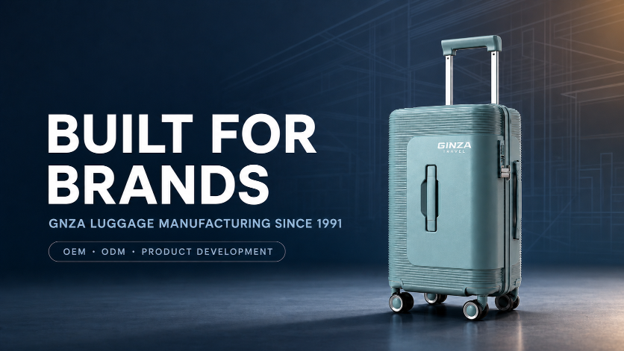
Inside GNZA: How a Luggage Idea Becomes a Market-Ready Collection
A company profile built around the decisions that connect product intent, manufacturing and brand consistency
THE REAL PRODUCT
A finished suitcase is only the visible result. Behind it sits a chain of decisions—about the traveler, dimensions, structure, materials, tooling, components, brand rules, testing, production and delivery. The strength of a manufacturing partner lies in how consistently that chain is managed.
ZHEJIANG YINZUO CASES & BAGS CO., LTD., known internationally through the GNZA name, has been developing and manufacturing luggage since 1991. Based in Pinghu, Zhejiang, the company works with brands, importers, retailers, distributors and private-label teams that need more than a catalogue item: they need a product that can carry a defined market position through development and into repeatable production.
That distinction shapes this company profile. Rather than treating scale as the whole story, it looks at the operating system behind the factory—the people, technical choices and approval points that turn an initial idea into a coherent luggage collection.
From a 1991 workshop to an integrated luggage platform
GNZA's history spans more than three decades of change in luggage materials, travel habits, retail channels and brand expectations. The company was established in 1991 and later developed its manufacturing base in Pinghu, a major luggage-production cluster in Zhejiang. Its public timeline records a move to Pinghu in 2005 and a shift toward smart manufacturing in 2015—milestones that reflect a broader transition from production capacity alone to integrated product development.
The current official company profile distinguishes a 66,000-square-metre site from 107,000 square metres of building area. It also reports nearly 1,000 professionals and 20 production lines. Those figures establish the physical platform; their commercial value depends on how effectively design, engineering, manufacturing, quality and logistics work together.
1991 66,000 m² 107,000 m² 20
Company founded Site area Building area Production lines
SCALE WITH A PURPOSE
For a buyer, scale should create room for parallel development, disciplined production planning, repeatability across a range and a clearer path from approved sample to delivery—not simply a larger number in a brochure.
Why a luggage manufacturer needs to act like a development partner
Luggage combines a visible fashion surface with a hidden mechanical system. The shell or textile body has to work with wheels, trolley components, handles, closures, internal organization, protective structures and packaging. A late change to one element can affect weight, cost, tooling, assembly and visual balance elsewhere.
The company's business workflow connects the stages that buyers often experience as separate suppliers: design and 3D modelling, mould and tooling work, manufacturing, warehousing and global logistics. The value of this connection is not that every project follows one rigid template. It is that dependencies become visible early enough to manage.
Stage Core decision Buyer-facing output
1. Brief alignment Traveler, channel, price position, launch timing and non-negotiable brand rules A development brief with priorities, constraints and approval owners
2. Design and 3D Proportion, silhouette, feature placement, range relationship and visual direction Reviewable concepts and dimensional definition
3. Material and structure Shell or textile architecture, closure, wheel/trolley system, interior and target performance A build direction and component logic
4. Tooling and sampling What requires a new mould, what can be configured, and what each sample must prove Sample plan, tooling decisions and tracked revisions
5. Manufacturing and quality Approved references, process controls, test criteria and change discipline Repeatable production against an agreed standard
6. Warehousing and delivery Packing, assortment, documentation, shipment windows and destination needs A commercially usable delivery plan
Material choice begins with product architecture
A material name is not a product strategy. PC, ABS, PP, PC+ABS, aluminium-magnesium constructions and textiles each create different possibilities for weight, rigidity, impact behaviour, surface treatment, forming, tooling and target cost. The correct question is not which material is universally best, but which architecture best supports the intended traveler, price point, visual language and validation plan.
Material direction What it can help the team explore Questions to settle in the brief
PC Premium surface options, resilience-led shell development and refined visual treatments Target thickness, finish, weight, impact criteria and cost boundary
ABS Cost-conscious hard-shell programmes and flexible surface design Reinforcement, forming details, expected use and finish durability
PP Integrated shell structures and projects balancing rigidity, resilience and weight Hinge/closure logic, mould strategy, texture and colour requirements
PC+ABS A blended route for balancing appearance, structure and programme economics Material ratio/specification, shell geometry and validation method
Aluminium-magnesium Frame-led, hardware-defined products with a distinctive technical character Frame precision, corner protection, closure, weight and target positioning
Textiles Soft luggage, backpacks, totes and coordinated travel accessories Fabric specification, reinforcement, stitching, organization and trim system
This is why early engineering dialogue matters. Material, geometry and component decisions should be reviewed as one system. Doing so reduces the risk of choosing an attractive surface first and discovering later that the intended weight, function, cost or production route no longer fits.
OEM and ODM: two starting points, one standard of execution
GNZA supports both OEM and ODM programmes. The distinction is less about which route is more sophisticated and more about where the project begins, who owns each decision and how much development work is required before sampling.
Project route Typical starting point GNZA contribution What the buyer should prepare
OEM Buyer-owned design, technical package or established product standard Manufacturing assessment, engineering coordination, tooling, sampling, production and quality execution Specifications, brand standards, target cost/quantity, approval process and required tests
ODM Market need, reference direction, feature list or incomplete product concept Concept development, 3D work, material/structure options, configurable features, sampling and manufacturing Target user, channel, price position, visual direction, launch timing and decision priorities
In both routes, the goal is the same: a product that can be approved clearly and reproduced consistently. A strong handover does not rely on memory or one physical sample alone. It connects drawings, specifications, approved colours and materials, component references, packaging requirements and recorded revisions.
Brand execution is more than placing a logo
A suitcase communicates a brand through proportion and touch before the traveler reads a name. Shell geometry, frame or zipper treatment, wheel stance, trolley and handle design, colour, surface texture, lining, dividers, pullers, badges and packaging all contribute to the same impression.
The development system therefore needs to protect brand intent at component level. Colour matching should account for different materials and surface finishes. Logo integration should be considered with construction and tooling, not added at the end. Channel variants should share enough common architecture to remain recognizable while allowing purposeful differences in colour, trim, interior layout or feature packages.
• Build the visual grammar. Define the silhouette, colour relationships, hardware language, textures and interior cues that must remain consistent across sizes.
• Control the touchpoints. Treat wheels, handles, closures, pullers, lining and dividers as brand interactions as well as functional components.
• Plan the family. Decide which parts, moulds or visual details can be shared and where size- or channel-specific differentiation adds value.
• Carry the standard into packing. Translate assortment, colour naming, labels, manuals, cartons and protective packing into the same controlled project record.
Quality is managed before final inspection
Inspection is essential, but it cannot repair an unclear brief. Reliable quality begins with defined references and approval gates: which sample is the master, which dimensions are critical, which test methods apply, who can approve a colour deviation, and how an engineering change is recorded after approval.
For luggage, this discipline should extend to the parts that receive repeated force and contact—wheels, trolley systems, carry handles, zippers or frames, locks, hinges, corners and internal attachment points. The relevant validation plan depends on the product, destination market and buyer standard. Those requirements should be confirmed project by project rather than replaced by a generic promise.
A PRACTICAL QUALITY PRINCIPLE
Freeze what has been approved, name what remains open, and record every change that affects fit, function, appearance, testing, cost or delivery. Quality becomes more predictable when the decision trail is as clear as the physical sample.
What the model is built to support
The company's development and manufacturing platform can serve several commercial models: established luggage brands extending a range; retailers building private-label collections; importers and distributors adapting products to a market; e-commerce teams that need clear variant architecture; and corporate programmes requiring brand-specific travel products.
The product scope extends from zipper and frame-closure wheeled luggage to backpacks, totes, cosmetic cases, luggage covers and coordinated travel accessories. The useful question for any category is the same: which parts of the product should be distinctive, which should be standardized, and which decisions create the greatest value for the target customer?
A better first brief for GNZA
A first conversation does not require a complete technical pack. It does require enough commercial context to make the next development step meaningful. The following six layers give the team a useful starting point.
Brief layer Questions to answer Why it matters
Business context Target market, channel, customer, price position, expected quantity and launch window Sets the commercial boundaries for design and manufacturing decisions
Range architecture Single item or family? Sizes, hero SKU, colour count and channel variants? Prevents one sample from being developed without a range logic
Brand language Which shapes, colours, materials, hardware or details are non-negotiable? Turns brand identity into controllable product decisions
Performance intent Weight, impact, mobility, closure, security, organization and surface priorities? Guides material, structure, component and test choices
Project route OEM, ODM or a hybrid? Existing drawings, reference samples, tooling or component standards? Defines ownership, development scope and the fastest credible route to sampling
Approval system Who approves design, colour, function, tests, packaging and commercial changes? Creates a clean path from sample revisions to production release
From an idea to a collection that is ready to move
GNZA's company story is ultimately a story about integration. Manufacturing capacity matters, but the decisive capability is the ability to keep a product's commercial intent, technical definition, brand expression and production reality aligned from the first brief onward.
For buyers planning a new luggage programme, the most productive starting point is not a request for every possible option. It is a clear statement of who the product is for, where it will sell, what the brand must protect and what the first sample needs to prove. From there, the development team can compare routes, expose trade-offs and build a collection with a stronger reason behind every decision.
START A PRODUCT CONVERSATION
Share your target user, channel, price position, range plan, brand direction and intended launch window. GNZA can use that context to structure the first development questions and define a more purposeful path to sampling.