How GNZA Builds Coordinated Travel Collections Across Hard Luggage and Soft Bags
How GNZA Builds Coordinated Travel Collections Across Hard Luggage and Soft Bags
A product line becomes more useful when every item has a clear job and the whole range still feels like one brand
A suitcase rarely travels alone. A carry-on may be paired with a backpack for devices and documents, a weekender for flexible packing, or a tote for the last part of the journey. For a luggage brand, that simple observation changes the development question. The goal is no longer to make one attractive case. It is to build a family of products that works across different carrying modes, price points and retail moments.
Zhejiang Yinzuo Cases & Bags Co., Ltd., the company behind GNZA, approaches this challenge as a collection-development program. Hard luggage brings structure, mobility and a strong visual anchor. Soft bags add access, flexibility and more frequent use. When these categories are designed together, a buyer can present a coherent travel story instead of a group of unrelated SKUs.
The market signal favors a broader travel system
Travel demand remains substantial, but it is not moving in one simple direction. IATA's June 2026 outlook forecast global passenger traffic growth of 2.1% for the year. Its July release later reported total passenger demand 0.2% above July 2025. These figures do not measure luggage sales, yet they describe an active travel market with uneven momentum. In that environment, a balanced assortment can be more resilient than a range built around a single product assumption.
Search behavior points in the same direction. In a worldwide five-year Google Trends comparison collected on 7 September 2026, the average relative interest index was 16 for travel bag, 7 for carry on luggage, 7 for travel backpack, 2 for weekender bag and 1 for hard shell luggage. The numbers are normalized within that comparison and are not search volumes. Their value is the pattern: travelers use a broad category term while continuing to search for specific carrying formats.
Search language | Five year average index | Product planning implication |
Travel bag | 16 | Keep the collection broad enough to meet general travel needs |
Carry on luggage | 7 | Use the wheeled case as a visible anchor product |
Travel backpack | 7 | Treat hands-free carrying as a core role, not an accessory afterthought |
Weekender bag | 2 | Use flexible capacity and short-trip use to extend the range |
Hard shell luggage | 1 | Pair material-led language with benefits, use cases and collection context |
A separate sourcing comparison adds a useful B2B perspective. Custom backpack averaged 54, custom luggage 28, luggage manufacturer 12 and OEM luggage 6 within its own five-term set. Again, these are relative signals, not market shares. They suggest that buyers often search through a product type and a customization need before they search through manufacturing jargon. A supplier therefore has to show the actual range, explain the customization path and make its production competence visible through products.
A collection starts with roles rather than matching colors
The quickest way to make a product family look coordinated is to repeat a color. The stronger method is to define the role of each item first, then translate one brand language across different constructions. GNZA begins with the journey, channel and price architecture. The team can then decide which product should lead the range and which items should increase utility, basket size or frequency of use.
Collection role | Example reference | Decision to make |
Hero mobility product | A-303L mint hard-shell suitcase | Size plan, shell material, closure, wheel and trolley system, interior and channel position |
Daily travel companion | Cream and olive multi-pocket backpack | Access hierarchy, device organization, back and strap comfort, reinforcement and usable volume |
Flexible short-trip carrier | Cream and olive weekender or duffel | Opening, handle and shoulder-carry balance, base structure, packing flexibility and trim durability |
Attach and lifestyle items | Tote, crossbody or cosmetic case | Price ladder, giftability, brand visibility and relationship to the anchor products |
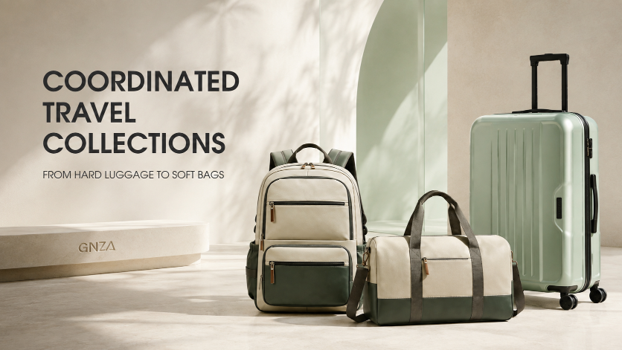
The A-303L and the cream and olive soft-bag family illustrate this logic without pretending that hard and soft constructions are identical. The suitcase uses a restrained mint shell, vertical groove rhythm and dark functional lines. The backpack and weekender combine light neutral panels with dark olive bases and gray webbing. Their connection comes from proportion, calm color relationships and controlled contrast rather than copied surface details.
One visual language needs different engineering
Hard luggage and soft bags communicate through different materials. A molded shell creates its identity through geometry, surface treatment, corner transitions, frame or zipper lines and component integration. A textile bag depends on panel layout, stitching, reinforcement, webbing, zipper paths, pocket volumes and how the body holds its shape when empty or loaded.
This means collection consistency cannot be managed with a color code alone. The team has to translate brand cues across material systems. A shell groove may become a vertical seam or webbing line. A recessed shell zone may become a pocket block. A dark zipper track may reappear as an olive lower panel or charcoal trim. The aim is recognition across categories while allowing each product to perform its own job.
Material decisions stay connected to use
For hard-shell projects, the company's development scope includes PC, ABS, PP, PC and ABS blends, and aluminum constructions. For backpacks, totes and travel bags, textile specification, coating, lining, reinforcement, foam, webbing and hardware become equally important. The correct material choice depends on the target traveler, use pattern, price position, weight goal, surface direction and validation plan.
The selected catalog references should therefore be treated as development directions, not a universal specification. A buyer may keep the same visual family while changing the shell material, size architecture, interior package, fabric grade, pocket configuration or trim system for a particular channel. Those changes need to be reviewed as a system because one decision can affect cost, weight, tooling, sewing complexity, appearance and testing.
GNZA connects design intent to repeatable production
The value of a coordinated collection is lost if the approved concept cannot survive sampling and production. The operating task is to keep the relationships between products visible through every revision. That requires a shared brief, clear approval owners and reference standards for color, material, components and workmanship.
Development stage | What the team aligns | Buyer output |
Collection brief | Target user, journey, channel, price ladder, category roles, launch window and brand rules | A priority map for the whole range |
Concept and architecture | Silhouettes, proportions, visual connections, size plan and feature hierarchy | A coordinated concept set for review |
Materials and components | Shell or textile system, colors, lining, wheels, trolley, handles, zippers, webbing and hardware | A bill of materials direction and sample standard |
Prototype and validation | Fit, loading, rolling, carrying, closure, wear points, appearance and market-specific requirements | Tracked samples and a decision record |
Production preparation | Tooling, patterns, process controls, approved references, packaging and inspection criteria | A repeatable production package |
Delivery readiness | Assortment, cartons, labels, documentation, timing and destination requirements | A shipment plan connected to the launch |
GNZA's current corporate profile reports a 66,000 square meter manufacturing site, 20 production lines, annual capacity of more than six million pieces, exports to more than 80 countries and work with more than 100 global brands. Scale matters here because a multi-category range creates more coordination points than a single SKU. The commercially relevant question is whether design, engineering, sampling, production, quality and delivery can operate against one approved collection standard.
OEM and ODM programs need different inputs
An OEM collection usually begins with a buyer-owned design, technical package or established product standard. The manufacturer's role is to assess feasibility, coordinate engineering, prepare tooling or patterns, develop samples and reproduce the approved result. An ODM collection can begin earlier, with a target user, market gap, visual direction and feature priorities. The team then helps turn that direction into a defined product architecture.
Both routes work better when the buyer separates non-negotiable brand elements from configurable features. A logo position may be fixed while the interior organization changes by channel. A hero color may remain consistent while secondary colors vary by season. A core shell or bag body may be shared while pockets, trims, packaging or accessory bundles create price steps. This discipline protects recognition without forcing every SKU to be identical.
What buyers should prepare before development
A productive first discussion does not require a finished specification. It does require a commercial point of view. The following inputs allow the development team to make better decisions earlier.
· Target traveler and use cases, including trip length, transport mode and what each product must carry
· Sales channels, destination markets and intended price ladder
· The role of the hero suitcase, backpack, weekender and any attach products
· Brand rules for color, logo, proportion, finish, hardware and packaging
· Required sizes, target weight and must-have functions
· Expected order structure, launch timing, sampling milestones and approval owners
· Applicable testing, labeling, chemical, social-compliance and market requirements
When some inputs are still open, the team can use the first sample round to test defined hypotheses instead of simply producing another visual option. One sample might compare pocket access, another material or base reinforcement, and another color or trim execution. Each round should answer a decision that moves the complete range toward production.
A stronger collection is easier to explain and harder to replace
Coordinated travel products create value on several levels. The retail presentation becomes clearer. Product photography and campaign language can work across a range. Buyers can build good better best steps or channel-specific bundles. Customers can add a second product without leaving the brand's visual world. Behind the scenes, shared decisions about materials, colors, components and packaging can also improve development discipline.
The strategic advantage is not visual uniformity. It is a product system in which each item has a reason to exist and every item contributes to the same brand promise. That is the purpose of GNZA's collection-development approach across hard luggage and soft bags.
Start the next travel collection with a range brief
Share the target market, channel, traveler, price architecture and preferred product roles with the GNZA team. Referencing a hero case such as A-303L and a coordinated backpack or weekender direction can give the first conversation a concrete starting point. From there, the team
can map the OEM or ODM route, identify decisions that need validation and prepare a sample plan for a coherent, market-ready range.