Top 10 Luggage Trends in 2026: What Buyers Need to Know
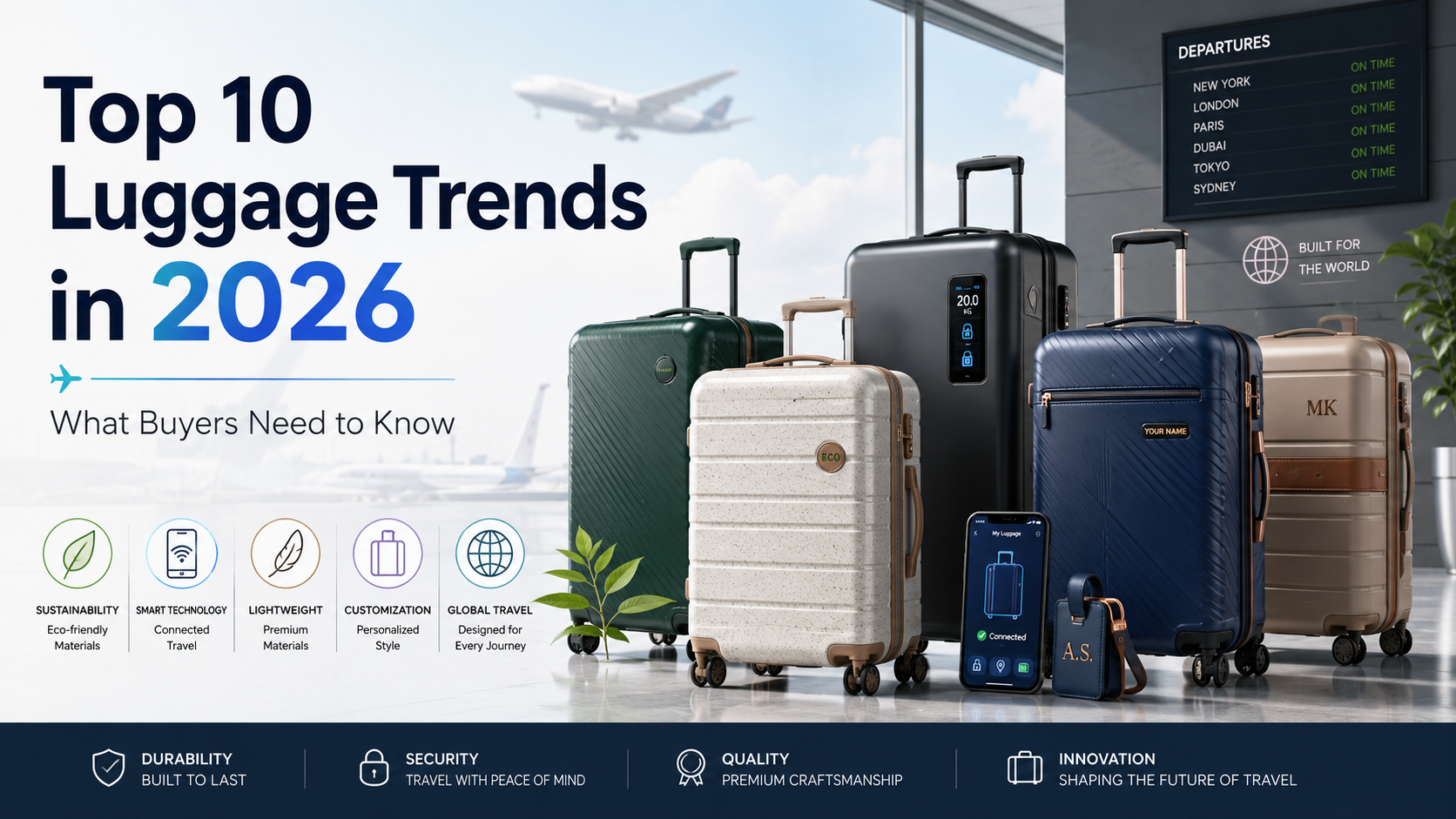
Top 10 Luggage Trends in 2026: What Buyers Need to Know
The luggage market is experiencing rapid change. Travel patterns are shifting post-pandemic. Materials innovation is accelerating. Customization, sustainability, and smart technology are becoming standard expectations, not luxuries.
For luggage retailers, brand owners, and travel goods buyers, understanding 2026 trends is critical to inventory planning, product development, and marketing strategy. This guide surveys the top 10 trends shaping the luggage industry right now.
2026 Luggage Market Overview
The global luggage market is valued at approximately $35–$40 billion annually (2026 estimate). Growth is steady at 4–6% year-over-year, driven by:
• Increased travel frequency (especially in Asia and emerging markets)
• Business travel recovery (corporate travel budgets are normalizing post-pandemic)
• Leisure travel expansion (experiences-focused spending by younger demographics)
• Rising middle class in Asia (new travelers purchasing luggage for the first time)
Within this market, several distinct trend lines are emerging. Here are the 10 most significant.
Trend 1: Sustainable Materials Becoming Standard, Not Optional
What's Happening: Brands are rapidly transitioning from virgin polycarbonate to recycled or bio-based alternatives. In 2026, expect to see:
• Recycled polycarbonate (rPC): Post-consumer recycled PC reduces carbon footprint by 30–50% vs. virgin PC. Cost premium: 5–10%. Major brands (Samsonite, American Tourister, Delsey) are integrating rPC into 20–30% of lineups.
• Bio-based polycarbonate: Plant-based PC alternatives (derived from plant sugars) offer 50%+ carbon reduction. Still premium (20–30% cost increase) but scaling rapidly. Expected to reach 5–10% of market share by 2026.
• Recycled aluminum: Lighter, lower-carbon alternative to virgin aluminum. Used in hybrid designs (aluminum frame + recycled PC shell).
Buyer Implication: If sourcing luggage, offer recycled material options or face retailer/distributor pressure. Premium positioning around sustainability is marketable; "eco-friendly" luggage commands 10–20% price premium in Western markets.
Manufacturing Impact: Factories with rPC/bio-PC sourcing relationships will grow share. Standard virgin PC/ABS suppliers will face margin pressure.
Trend 2: Smart Luggage Integration—Now Mainstream
What's Happening: GPS tracking, USB charging, weight sensors, and app connectivity are moving from luxury to mainstream by 2026.
• GPS-enabled luggage: $20–$40 price point (tracker device integrated into luggage). ~30% of mid-market luggage ($150–$300) now includes integrated tracking.
• Built-in power banks: USB ports with rechargeable internal battery (powers phone/laptop). Cost: $5–$15 to manufacture; retails for $30–$50 premium.
• Smart weight sensors: Luggage that alerts you via app if you're nearing airline weight limits. Cost: $10–$25; appeals to frequent business travelers.
• RFID/NFC integration: Anti-theft, quick identification, luggage matching at baggage claim. Low cost ($1–$3 per unit); high consumer appeal.
Buyer Implication: Smart luggage is no longer a niche luxury. If you're targeting business travel or premium segments, smart features should be standard. Consumers expect them.
Manufacturing Impact: Factories without electronics integration expertise are at disadvantage. Partnerships with electronics suppliers and assembly capability for circuit boards/batteries are becoming essential.
Trend 3: Aluminum-Magnesium Hybrid Materials Gaining Traction
What's Happening: Aluminum-magnesium (Al-Mg) alloy frames combined with polycarbonate shells are becoming the "premium standard" in 2026.
• Weight reduction: Al-Mg frame is 30–40% lighter than aluminum alone, offering rigidity with minimal weight penalty.
• Cost efficiency: Al-Mg is 20–30% cheaper than full aluminum luggage while maintaining premium perception.
• Manufacturing scale: Chinese factories are rapidly scaling Al-Mg production. Pinghu (Zhejiang) now has 10+ manufacturers offering Al-Mg expertise.
Buyer Implication: Al-Mg hybrid designs are ideal for mid-to-premium segments ($200–$400). Market expects this material combination; "premium luggage" without it feels outdated.
Manufacturing Impact: Factories with Al-Mg frame manufacturing capability will outcompete pure plastic manufacturers in premium segments.
Trend 4: Lightweight Priority—The 4-Lb Carry-On Ideal
What's Happening: Airlines are tightening weight restrictions and downsizing carry-on dimensions. Consumers are prioritizing lightweight luggage.
• Target weight for 22-inch carry-on: Under 4 lbs (1.8 kg) is now "lightweight marketing standard."
• Material drivers: Polycarbonate + Al-Mg frame achieves this; ABS carries penalty (minimum 4.5 lbs for same capacity).
• Ultralight segment: Brands targeting under-3.5 lbs for premium segments. Requires exotic materials (lightweight titanium, advanced composites)—expensive, niche market.
Buyer Implication: If sourcing carry-ons, specify lightweight materials (PC + Al-Mg frame). Heavy ABS luggage will face retailer/consumer resistance.
Manufacturing Impact: Designers must optimize wall thickness and material selection. PC/Al-Mg combinations require different tooling and assembly than traditional ABS.
Trend 5: Carry-On Dominance—Checked Luggage Declining
What's Happening: Business travelers and leisure travelers are increasingly avoiding checked baggage.
• Carry-on preference: 65–70% of flights now have carry-on-only booking options. Passengers are prioritizing carry-on travel.
• Checked luggage decline: Traditional large suitcase (28-inch checked) sales are declining 3–5% annually. Carry-on sales are growing 6–8% annually.
• Size standardization: IATA and airline alliances are standardizing carry-on dimensions (22" x 14" x 9" typical). This allows manufacturers to optimize for this single size.
Buyer Implication: Inventory mix is shifting hard toward carry-ons. Allocate less budget to checked luggage; prioritize carry-on assortments (multiple colors, styles).
Manufacturing Impact: Factories optimizing for carry-on production will serve demand better. Checked luggage becomes specialty/low-volume production.
Trend 6: FIFA 2026 World Cup Licensed Luggage—Collector's Item Market
What's Happening: With FIFA World Cup 2026 in Mexico, Canada, and the United States, licensed luggage featuring national team branding and flags is expected to be a significant seasonal trend (Q2–Q4 2026).
• Licensed products: Expect 15–20 countries to launch limited-edition World Cup luggage.
• Price premium: World Cup licensed luggage commands 15–25% retail premium over non-licensed equivalents.
• Volume concentration: High volume in Q3–Q4 2026; minimal demand outside that window.
• Manufacturing lead time: Licensed products require approval from FIFA and national federations. Lead time: 16–20 weeks (longer than standard).
Buyer Implication: If planning to participate in World Cup trend, source now (Q2–Q3 2026) for delivery by July 2026. Late sourcing will miss the market window. This is a seasonal spike; don't overcommit inventory.
Manufacturing Impact: Factories with licensing experience and the ability to navigate FIFA approval processes will win disproportionate volume Q3–Q4 2026.
Trend 7: Direct-to-Consumer (DTC) Luggage Brands Exploding
What's Happening: DTC luggage brands (selling direct to consumers via e-commerce) are growing 15–20% annually, capturing share from traditional retail.
• Examples: Away, Calpak, Cooler Luggage, and dozens of emerging brands are building loyal customer bases through direct sales.
• Customization expectation: DTC customers expect color options, material choices, and personalization (monogramming, custom prints).
• Margin capture: DTC brands eliminate retail margin; they capture 50–60% retail price as gross profit vs. 40–45% for traditional brands selling through retail.
Buyer Implication: If you're a brand, DTC is increasingly attractive. If you're a retailer, you're under margin pressure from DTC competitors. Traditional retail will require differentiation (exclusive colors, service, returns).
Manufacturing Impact: Factories with rapid customization capability and flexible MOQ will win DTC brand volume. Traditional high-volume production is less valuable.
Trend 8: Customization at Scale—No Longer One-Off
What's Happening: Manufacturing technology advances (digital printing, mold flexibility, modular design) are making customization cost-effective at 500–1,000+ unit volumes.
• Digital printing: Custom graphics, photos, logos printed on luggage surface at modest cost premium (5–10% vs. standard colors).
• Modular designs: Luggage designed so users can swap shells, handles, or wheels. "Platform" approach allows customers to customize.
• Made-to-order: Factories are now offering "make-to-order" services where customers order personalized luggage (color, pattern, engraving) within 6–8 weeks.
Buyer Implication: Mass-produced, off-the-shelf luggage is losing appeal. Customization (even at small scale) is increasingly expected. Plan for 20–30% of volume to be custom/semi-custom.
Manufacturing Impact: Factories without customization capability will lose volume to those offering it. Tooling flexibility and rapid color/design changes are competitive advantage.
Trend 9: Region-Specific Design Preferences Driving Differentiation
What's Happening: Luggage design is increasingly tailored to regional preferences rather than "one global design."
• Asian preferences: Larger external pockets (for items Asian travelers prefer to access), lighter overall weight, pastel/metallic colors.
• European preferences: Minimalist design, matte finishes, carry-on focus, sustainability emphasis.
• North American preferences: Hybrid wheel systems (spinner + wheels for rough terrain), spacious interiors, bold colors.
• Latin American/African growth: First-time luggage buyers prioritize durability and value over aesthetics.
Buyer Implication: If you're a global brand, regional design customization is now table-stakes. Single global design will underperform in mixed markets.
Manufacturing Impact: Factories need to understand regional preferences and adapt designs. One-size-fits-all manufacturing is obsolete.
Trend 10: Modular Luggage Systems—Mix and Match Components
What's Happening: Premium brands are launching modular luggage systems where customers can mix and match shells, frames, handles, and wheels.
• Concept: Customers buy a base unit + interchangeable components. Upgrade without replacing entire suitcase.
• Sustainability angle: Modular design extends product lifespan. Replace broken wheel without discarding luggage.
• Brands leading: Rimowa (modular frame systems), Away (partnership models), and emerging brands are pioneering this approach.
• Manufacturing challenge: Requires precision tolerances and standardized interfaces across components.
Buyer Implication: Modular luggage is aspirational, premium positioning. If targeting affluent, sustainability-conscious customers, modular design is differentiator.
Manufacturing Impact: Factories with precision injection molding and modular design expertise can command premium positioning.
Forward-Looking Takeaway: What This Means for 2026 and Beyond
The luggage industry is maturing. Commoditized, basic suitcases are declining. Premium features (smart technology, sustainable materials, lightweight design, customization) are becoming baseline expectations.
For buyers: Invest in:
• Lightweight materials (PC/Al-Mg combinations, rPC)
• Customization capability (colors, personalization, design flexibility)
• Smart features (tracking, charging, weight sensors)
• Sustainability credentials (recycled materials, ethical manufacturing)
• Regional product variants (Asia, Europe, North America tailored designs)
For retailers: Curate assortments around:
• Carry-on focus (70% carry-on, 30% checked)
• Premium brands with smart features and sustainability
• DTC brands offering differentiation
• World Cup/seasonal licensed products (Q3–Q4 2026 peak)
For manufacturers: Develop capabilities in:
• Recycled and bio-based material sourcing
• Electronics integration (GPS, USB, sensors)
• Al-Mg frame manufacturing
• Rapid customization and digital printing
• Regional design variants
• Modular system design and precision tolerances
The luggage market in 2026 is not static. It's dynamic, innovation-driven, and increasingly customer-centric. Buyers and manufacturers who anticipate these trends will capture disproportionate share.
Frequently Asked Questions
Q1: Will sustainable luggage become affordable, or will it stay premium?
A: Prices will narrow. In 2026, recycled PC should reach price parity with virgin PC (as scale increases). By 2027–2028, expect rPC to be cheaper than virgin PC due to supply-chain efficiencies. Early adopters pay premium; mainstream adoption = cost convergence.
Q2: Is smart luggage a gimmick, or will it become standard?
A: It's becoming standard. GPS tracking is now expected in mid-market luggage. Brands without smart features will be perceived as outdated. By 2026, expect 40–50% of luggage ($150+) to include smart features.
Q3: Will World Cup 2026 luggage be a major sales driver?
A: Yes, seasonally. Q3–Q4 2026 will see significant licensed luggage volume. However, post-tournament, demand will collapse (normal seasonal pattern for licensed goods). Plan conservatively; don't overstock.
Q4: Is modular luggage the future, or a luxury niche?
A: Currently a luxury niche (< 5% of market). By 2028–2030, expect 10–15% of market as manufacturing scales and costs decline. For 2026, it's still aspirational/premium positioning.
Q5: Should I avoid ABS luggage in 2026?
A: No, but allocate less. ABS remains viable for budget segments (< $100 retail). For mid-market and premium, shift to PC and Al-Mg. Expected split by 2026: 40% ABS, 50% PC/PC+ABS, 10% Al-Mg and specialty.
Conclusion
The luggage market in 2026 is increasingly sophisticated. Sustainability, smart features, lightweight design, and customization are shifting from nice-to-haves to expectations. Buyers and manufacturers who invest in these capabilities early will outpace those clinging to commodity approaches.
For luggage industry observers, brands, and retailers: the trends are clear. Adapt your sourcing, product development, and marketing accordingly. The future of luggage is premium, personalized, and planet-conscious.