Luggage Manufacturing China vs Southeast Asia Cost Comparison
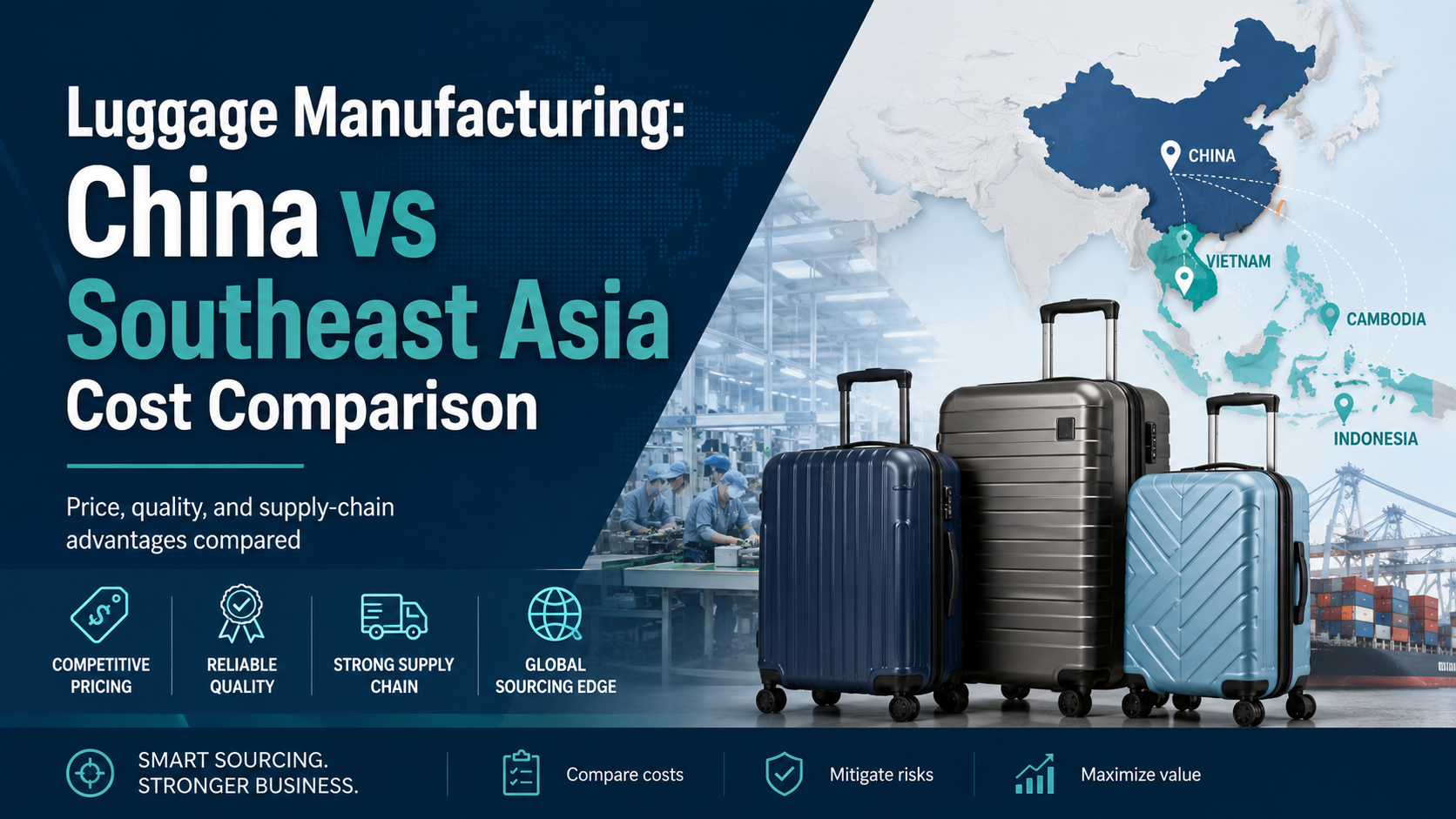
Luggage Manufacturing: China vs Southeast Asia Cost Comparison
The geopolitics of manufacturing are shifting. Trade tensions, tariffs, and labor cost increases in China are pushing Western brands to explore Vietnam, Indonesia, and Cambodia as alternative sourcing hubs. Yet the narrative is incomplete: China remains deeply competitive, and the “China vs Southeast Asia” choice is rarely binary.
This guide compares cost structures, production capacity, quality systems, and supply-chain maturity across China and Southeast Asia, helping buyers decide where to source and when hybrid strategies make sense.
1. The Shift: Why Brands Are Looking Beyond China
Three factors are driving the de-risking conversation, while a fourth factor influences how brands position sourcing decisions to customers and retailers.
Driver | What it means for luggage sourcing |
U.S.-China trade tensions and tariffs | Section 301 tariffs, averaging 19-25% on Chinese imports, can add meaningful cost to finished goods. Vietnam, as a non-tariff target, has offered temporary advantage, although this advantage may erode as trade tensions increase. |
Labor cost escalation | Chinese wages in manufacturing hubs such as Zhejiang have risen 8-12% annually over the past decade. A factory worker in Pinghu earns about $400-$600/month; in Vietnam, $250-$400/month. |
Supply-chain risk management | The COVID-19 pandemic exposed concentration risk. Dual-sourcing, such as China + Vietnam or China + Indonesia, has become a risk-mitigation strategy even when the cost premium is small. |
Geopolitical positioning | Brands targeting ESG-conscious buyers increasingly highlight diversified sourcing or non-China manufacturing as a selling point, even when the total cost is similar. |
2. Production Capacity: China’s Continued Dominance
Region | Estimated manufacturer base | Estimated annual capacity | Capability profile |
China | 300+ manufacturers, concentrated in Pinghu/Zhejiang | ~300 million pieces annually | Highly integrated supply chain; strongest for hardside luggage, custom tooling, TSA locks, hybrid materials, and advanced features. |
Vietnam | 50-80 manufacturers, mostly smaller operations | ~40-50 million pieces annually | Growing but still nascent; can handle standard orders, but custom development is slower. |
Indonesia | 30-40 manufacturers, primarily softside luggage | ~20-30 million pieces annually | Limited hardside expertise; better suited to basic or entry-level products. |
Cambodia | 5-10 manufacturers | ~5-10 million pieces annually | Mostly entry-level/budget products with minimal technical capability. |
What this means: If you need 5,000+ pieces of hardside polycarbonate luggage with advanced features, China’s scale and depth remain unmatched. Vietnam can handle 2,000-5,000 units but often with longer lead times and higher per-unit costs. Indonesia and Cambodia usually lack the infrastructure for anything beyond basic ABS carry-ons.
3. Cost Breakdown: Material, Labor, and Overhead
The following comparison uses a standard 24-inch polycarbonate spinner at a 2,000-unit order quantity. Values are shown as estimated wholesale cost components per unit.
Cost component per unit | China (Pinghu) | Vietnam (HCMC) | Indonesia (Jakarta) | Cambodia (Phnom Penh) |
Material: PC resin, hardware, wheels, lock | $16.50 | $16.50 | $16.50 + 3-5% logistics friction | $16.50, sourced via Vietnam |
Labor: injection molding, assembly, QC | $3.50 | $2.20 | $2.00 | $1.80 |
Overhead: rent, utilities, management, port logistics | $2.00 | $2.50 | $3.00 | $3.50 |
Tooling amortized, if custom | $1.50 | $1.80 | $2.20 | $3.00 |
Factory margin | $2.50 | $2.50 | $2.50 | $2.00 |
Estimated wholesale price | $26.00 | $25.50 | $26.20 | $26.80 |
Buyer cost with importer markup | $27.50-$29.00 | $27.00-$28.50 | $27.70-$29.20 | $28.50-$30.00 |
Key insight
On a 2,000-unit order, the cost difference is minimal: often only $0.50-$2.00 per unit. Vietnam can offer slight savings through lower labor cost, while Indonesia and Cambodia often lose that advantage through overhead, tooling, logistics, and supply-chain friction.
4. Quality and Compliance: Trade-offs by Region
Category | China (Zhejiang) | Vietnam | Indonesia | Cambodia |
Quality systems | Mature. ISO 9001, BSCI, and SEDEX are common. In-process QC at 25%, 50%, 75%, and 100% is expected. | Growing. Larger factories may have ISO 9001; smaller factories may lack formal certification. | Basic. Only top-tier factories have ISO 9001; BSCI/SEDEX are rare. | Minimal. Only the largest 2-3 factories have formal QC; many rely on visual inspection. |
Certifications | ASTM, EN, TSA compliance and international testing are readily available. Typical turnaround: 2-4 weeks. | ISO 9001 and basic BSCI are achievable; ASTM/TSA testing often outsourced to China or Thailand, adding 3-4 weeks. | Limited. ISO 9001 exists in a few factories; international certification requires external labs. | Essentially none locally; external testing adds cost and timeline. |
Custom design lead time | 12-16 weeks | 14-18 weeks | 16-20 weeks | 20-24 weeks |
Warranty and after-sales | Established practices; rework or replacement within about 30 days is typical. | Variable; larger factories are responsive, smaller factories may lack formal processes. | Inconsistent; language and technical-depth issues can slow claims. Rework turnaround may be 6-8 weeks. | Poor; language barriers and weak processes make claims difficult. |
Supply-chain maturity | Exceptional. Plastic pellet suppliers, mold makers, hardware vendors, and dyers are often within 50km. | Developing. Materials often imported from China or Thailand; custom molds frequently subcontracted. | Underdeveloped. Material sourcing is difficult; mold makers are scarce or non-existent. | Very underdeveloped. Materials imported; limited local expertise. |
5. Where Each Region Wins: Strategic Fit
Choose this region if... | China | Vietnam | Indonesia | Cambodia |
Order profile | 5,000+ units annually or 2,000+ per order | 1,500-3,000 units per order | Entry-level budget luggage | Ultra-low-cost luggage below $15 wholesale |
Product complexity | Custom designs, complex features, hybrid materials, advanced locks, custom tooling | Standard design or shared mold with minimal customization | Simple ABS carry-ons; no custom tooling required | Basic market-test SKUs with high tolerance for variance |
Timeline tolerance | Fast turnaround: 8-12 weeks standard, 12-16 weeks custom | 14-18 weeks acceptable | 16-20 weeks acceptable | 20+ weeks acceptable |
Quality expectation | Proven quality systems, audits, transparent communication | Can accept 3-5% quality variability or additional QC investment | Willing to invest in supplier development and communication management | Prepared for significant quality variance and ongoing supplier development |
Cost note | 5-10% labor premium vs. Vietnam, often offset by efficiency | 3-5% per-unit savings vs. China, often offset by longer lead time/rework | 5-10% nominal savings, but friction can remove the advantage | 10-20% nominal savings, but severe operational risk |
China is the strongest option when buyers need complex features, rapid problem-solving, and dependable quality systems. Vietnam is the strongest Southeast Asian alternative when buyers want diversification with manageable risk. Indonesia and Cambodia may work for tactical, price-sensitive programs, but they are less suitable for brand-critical or technically complex products.
6. Hybrid Sourcing Strategy: The Smart Approach
Industry best practice is dual-source not primarily for cost savings, but for risk mitigation. The following models give buyers a practical way to split volume without sacrificing the advantages of China’s mature supply chain.
Model | Production split | Cost impact | Main benefit |
Model A: Core + Test (China + Vietnam) | Core production of 2,000+ units annually in China; test/new designs of 500-1,000 units in Vietnam. | Minimal. Test-order premium is offset by core-order efficiency. | Reduces single-vendor risk and evaluates Vietnam for future scaling. |
Model B: Standard + Premium (China + Indonesia) | Standard/budget line in Indonesia; premium/custom line in China. | Possible 5-8% blended savings vs. all-China. | Optimizes cost by product tier while retaining China expertise for complex designs. |
Model C: Seasonal Load Balancing (China + Vietnam) | Peak season production in China; off-season production in Vietnam. | Possible 2-3% premium during off-season. | Reduces lead-time pressure and improves inventory management. |
Best-fit volume range
These models are most useful for mid-market luggage brands sourcing roughly 5,000-20,000 units annually.
7. Quality Control Across Regions: What to Inspect
Whatever region you choose, quality varies by factory rather than geography alone. Budgeting for third-party inspection is essential, especially when working with new vendors or less mature supply chains.
Inspection type | Timing | Typical cost | How to use it |
Pre-production sample inspection | At 0%, before setup | $200-$300 | Validate materials, dimensions, appearance, functional parts, and production readiness before mass production. |
In-process inspection | At 25%, 50%, 75%, and 100% of production | $500-$800 | Essential for Vietnam and Indonesia; standard practice in China. Helps catch recurring defects before the order is complete. |
Final inspection / PSI | Before shipment | $200-$400 | Recommended for all orders above 1,000 units. Confirms workmanship, packaging, labeling, carton marks, and AQL pass/fail status. |
Inspection response time also differs by market: China-based agencies may respond within 2-3 days, Vietnam within 5-7 days, and Indonesia within 7-10 days. That response-time gap can affect the overall production timeline.
8. Frequently Asked Questions
Q1: Should I switch from China to Vietnam to reduce costs?
Only if you can absorb 2-4 additional weeks of lead time and invest in supplier development. Actual per-unit cost savings are usually 3-5% at best and may become negligible after longer lead times and quality rework. A better first step may be negotiating volume discounts with your China supplier, which can sometimes yield 8-10% savings without quality trade-offs.
Q2: Is Vietnam a good long-term sourcing alternative?
Vietnam is growing and has potential, but it remains behind China in supply-chain maturity. A practical approach is to use Vietnam for non-critical orders such as test colors or new designs while maintaining China as the core supplier. As the vendor matures, buyers can consider shifting 30-50% of volume.
Q3: What is the actual tariff impact on China sourcing?
U.S. tariffs on luggage are about 19-25% ad valorem on finished product value. A $25 cost unit can become roughly $31 landed in the U.S. Vietnam has enjoyed a temporary tariff advantage, but tariff conditions can change, so the advantage should not be treated as structural.
Q4: Are Indonesia and Cambodia reliable for ongoing orders?
Not usually for brand-critical products. They can be suitable for budget/private-label lines where price sensitivity is high and product complexity is low. For longer-term partnerships, buyers should assess factory stability, language capability, technical depth, and quality response carefully.
Q5: How do I manage quality differences across regions?
Invest in third-party inspection, especially PSI. For new suppliers, external inspection should be used for the first 3-5 orders to establish a baseline, even when the factory has its own QC system.
9. Conclusion
The “China vs Southeast Asia” narrative is misleading. The real comparison is structural supply-chain maturity versus incremental cost savings. China offers shorter lead times, proven quality systems, and responsive supplier networks. Vietnam offers modest cost savings at the price of longer lead times and variable quality. Indonesia and Cambodia may serve tactical, low-cost needs, but they require stronger supplier management and realistic expectations.
For brands with strong cash flow and flexible timelines, Vietnam can make sense for 20-30% of volume. For brands with tight margins or fast-moving inventory, China’s speed and reliability remain difficult to beat.
Final position
Smart brands do not choose one region blindly. They optimize each product tier across regions: China for core and complex production, Southeast Asia for selected diversification and cost-sensitive programs.